
Delaware SMR task force tables preliminary recommendation after debate over funding and scope
Get AI-powered insights, summaries, and transcripts
Subscribe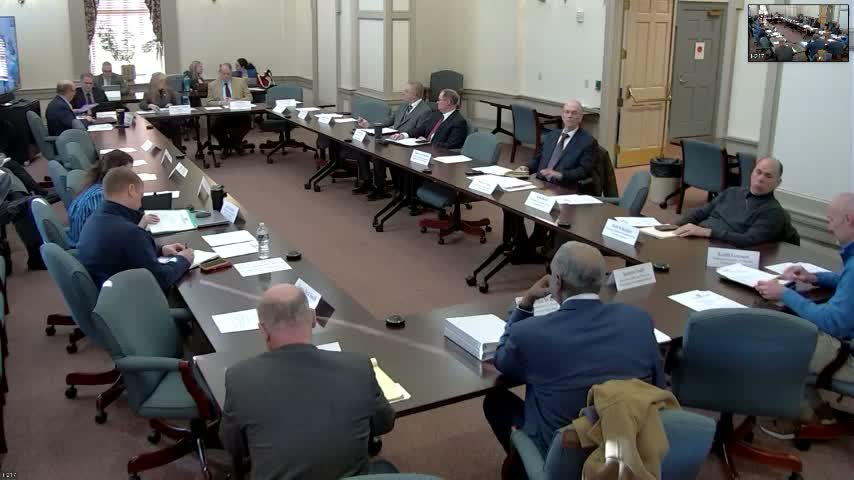
Summary
Facing questions about cost, workforce training and funding sources, the Delaware task force voted to table a preliminary recommendation that would have directed the state to promote construction of nuclear reactors including SMRs and to establish a non‑regulatory board. Members agreed to prepare written comments and resume discussion at the next meeting.
A Delaware legislative task force on small modular reactors voted to table a preliminary recommendation that would have urged the state to promote construction of nuclear reactors — including advanced and small modular reactors (SMRs) — and to create a non‑regulatory board to advise the governor and legislature.
The motion to table, moved by Jamieson and seconded by Keith Gosin, passed by voice vote after an extensive discussion by task force members who praised the proposal’s goals but pressed for more detail on cost, financing and workforce implications. During debate, members cited examples of state programs in New York, Tennessee and Texas and stressed the need for a plan to develop trades and technical training before committing funds.
The proposal, circulated to members in advance, recommended incentives for nuclear deployment, workforce development initiatives, strategic deployment programs and public outreach. Proponents framed the board as advisory and non‑regulatory. Opponents warned the plan contained assumptions about cost savings from SMRs that are not yet proven and flagged the limited Delaware tax base as a constraint when compared with larger states. One member referenced recent Georgia nuclear project costs as an example of high capital expense and noted that financing arrangements can transfer substantial costs to ratepayers.
After tabling the preliminary recommendation, the task force passed a separate motion directing members who wish to provide input to submit written comments to staff (Anna) before the next meeting. That motion passed after a roll‑call voice vote that recorded Peggy Schultz as opposed; several members abstained on the earlier tabling vote (including Dave Edgel and Representative Halofsky). Chair confirmed the item will return to the agenda at a future meeting for additional consideration.
The tabling preserves the group’s ability to refine the recommendation with targeted work: members asked staff to distribute the draft language and to collect written comments so the panel can identify items where there is consensus and areas that need further research. The task force also noted that a senate concurrent resolution passed since the last meeting has extended the group’s final report deadline to July (the resolution was described by the chair as giving the panel additional time to finish its work). The group set a next‑steps process and requested targeted follow‑up on funding sources, workforce development options and interactions with major site owners for possible locations.