
La Marque presents three draft FY27 budgets, warns of multi-year service cuts without new revenue
Get AI-powered insights, summaries, and transcripts
Subscribe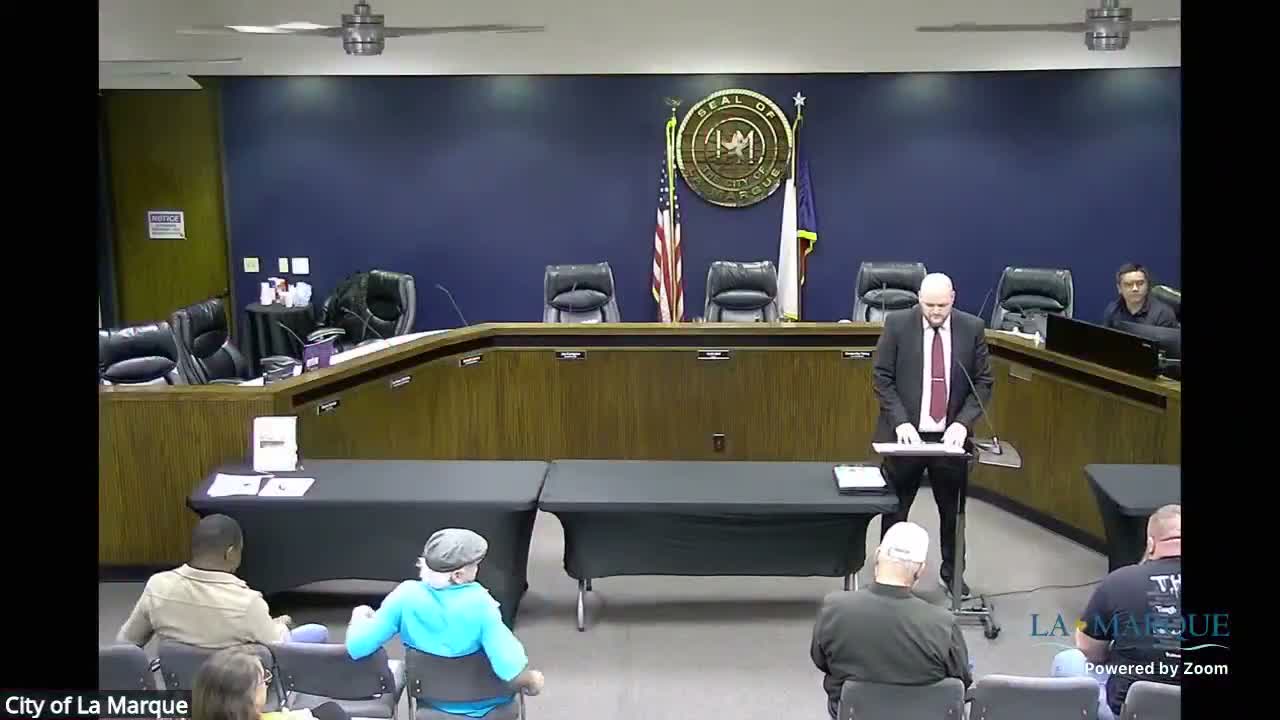
Summary
City officials previewed three draft FY27 budget scenarios — a no-new-revenue plan, a 3.5% property-tax scenario and a voter-approved option — and warned that, without recurring revenue or reserves, cuts totaling millions would be required and likely last several years.
W. Ferguson, a city official for the City of La Marque, opened a public meeting to present the first public draft of the fiscal year 2027 budget and to invite resident feedback. "Our goal is to try and help residents better understand the fiscal year 27 budget and the challenges associated," Ferguson said.
Ferguson told attendees staff prepared three rough-draft options for the general fund. The first, "no new revenue or reduced tax rate," would cut roughly $7–8 million from last year’s general fund budget — about a 25–28% reduction, which Ferguson described as "a severe reduction" that would force significant cuts to operations and services. The second option assumes a 3.5% increase in total property-tax collections, which Ferguson said is the maximum the council can approve without a citizen vote; staff estimate that option would leave about $5 million less than this year’s baseline. The third option, a voter-approved tax-rate increase, would reduce the shortfall to roughly $1–2 million compared with the current baseline.
Ferguson emphasized that the general fund and the enterprise (utility) fund are separate budgets. For the utility fund, staff modeled three scenarios — revenues below expectations (which Ferguson estimated would cause roughly a $1 million reduction and about a 10% cut), at expectation (roughly $250,000 savings achieved mainly through efficiencies), and above expectation (where extra receipts would be used to fund utility reserves rather than expand staffing).
Officials walked the public through concrete service impacts under deep cuts: longer EMS response times, reduced capacity to handle multiple fires, an elevated ISO rating that can raise homeowners’ insurance premiums, and fewer police officers on the street (Ferguson used the example of losing one officer per shift). Ferguson said departments were asked to prepare proportional cuts under each scenario (about 25% reductions in the no-new-revenue option, about 20% under the 3.5% option, and about 5% under a voter-approved increase).
The city plans to fund reserve and emergency funds for the general and utility funds over a three-year period, Ferguson said, which means the reduced service levels described would likely last at least three years and "probably more like four," owing in part to repayment of an EDC loan.
Ferguson laid out the public process ahead: staff will post rough drafts to the public in late March and hold five department-focused budget workshops (police/animal control; fire/code/development services; public works; city administration; and financial areas). Line-by-line council budget workshops are expected to begin in May. He also said staff intend to publish reconciled financial records from 2020–2025 online where legally permissible within roughly two months.
The presentation included specific financial estimates from staff; Ferguson noted the current budget had been balanced this year in part by one-time revenues (a $5 million mix of ADC loan proceeds, land sale and a railroad agreement) that will not recur next year, necessitating the modeled cuts.
The next steps are the late-March public workshops and subsequent council budget work sessions; staff asked residents to review the drafts and participate in the scheduled sessions.