Get Full Government Meeting Transcripts, Videos, & Alerts Forever!
Get email alerts on the Recount Procedures topic
No spam. Unsubscribe anytime.
Committee advances hand‑count recount bill despite clerks' warnings on timing and cost
Summary
House Bill 52, which expands hand-count options for recounts and creates an election recount account with a $200,000 appropriation, was reported out of committee 8-1 after extended testimony from the secretary of state's office, county clerks and civic groups expressing major implementation concerns.
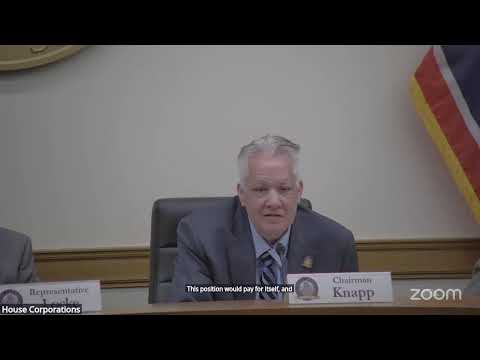
The Corporations Committee advanced House Bill 52 after extensive testimony and debate over whether counties have the time, staff and funding to implement hand‑count recounts statewide.
Joe Rubino, policy director and general counsel for the secretary of state's office, walked the committee through HB52 page by page. He said the bill changes the statutory definition of "recount" to permit hand counts in place of automatic machine retabulation, establishes thresholds that trigger recounts (a 2% county threshold and a 1% statewide/legislative threshold in certain races), authorizes counting boards to hand‑count ballots, sets deposit requirements for candidate‑requested recounts (machine recount deposit not to exceed $1,000; hand count deposit not to exceed $5,000), and creates an "election recount account" with a $200,000 appropriation to reimburse reasonable recount expenses. The bill lists an effective date of July 1, 2026.
The secretary of state (unnamed in the transcript) told the committee the measure is "one of the most vetted election bills in this session" and said he supports it while acknowledging implementation timing is difficult for the 2026 election. "This bill creates a mechanism to engage in those recounts," he said, and acknowledged working on amendments about the 2026 implementation timeline.
Malcolm Irvin, Platte County clerk and president of the County Clerks Association, urged the committee to restore timing and reimbursement language from the 2025 bill version. He warned counties could be saddled with an "unfunded mandate," noting the compressed timeline between polls closing and county canvassing (72 hours) and a narrow window for state canvassing and general‑election preparation. "We don't have sufficient time," Irvin said, and he handed proposed amendments to committee members.
Marguerite Herman of the League of Women Voters said hand counting is "fatally flawed" because of accuracy, reliability, timeline and manpower concerns, citing trials in Campbell County that revealed inconsistent results and high labor costs. Other witnesses, including a Sublette County canvassing-board member and the Wyoming Farm Bureau, offered conditional support but echoed the clerks' implementation concerns.
The committee considered a wholesale adoption of the County Clerks Association amendments; Minority Leader moved to adopt them but the motion failed. After further discussion the committee held a roll‑call vote on the bill; the clerk recorded eight yeas and one nay (Representative Yin). HB52 was reported out of committee and referred to appropriations with the $200,000 marker noted.