
Commissioner says OneGeorgia focuses on rural infrastructure, not direct grants to individuals
Get AI-powered insights, summaries, and transcripts
Sign Up Free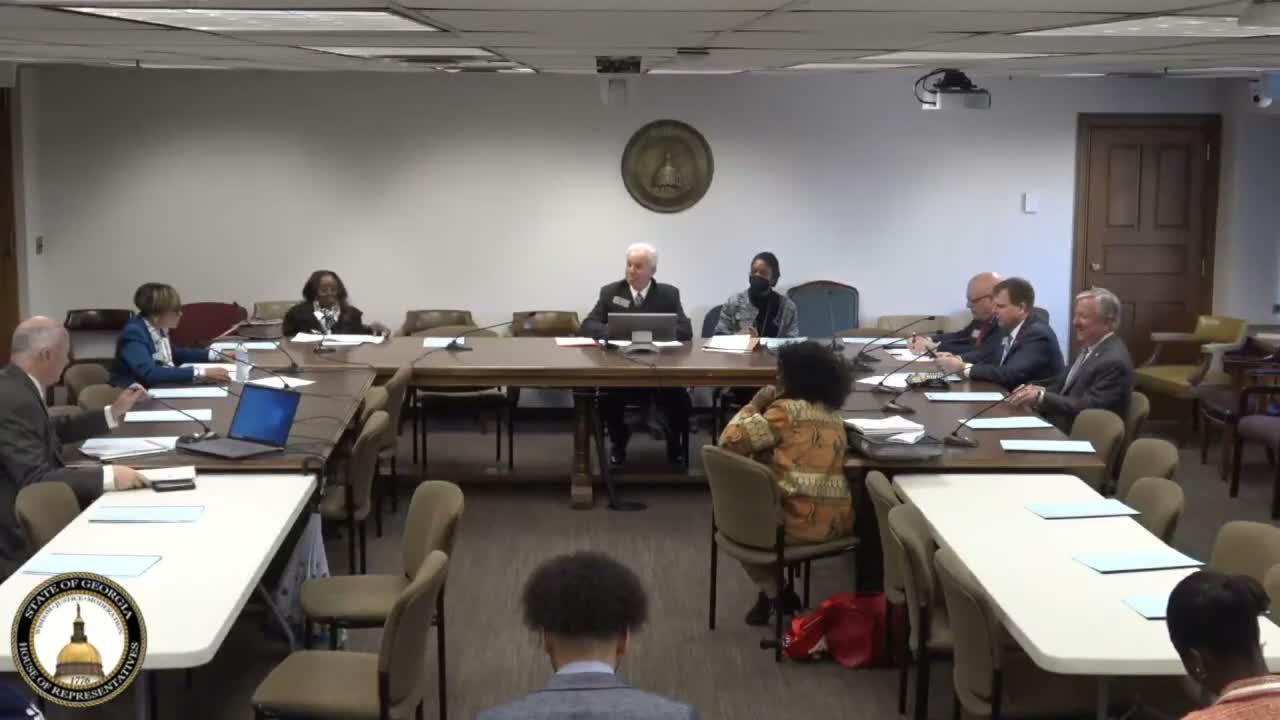
Summary
Commissioner Christopher Nunn told the House committee that the OneGeorgia authority—created after the 1998 tobacco settlement—invests in community infrastructure and site development to help rural counties attract jobs; eligibility, match requirements and complementary tools were explained during Q&A.
Commissioner Christopher Nunn told the House Committee on Economic Development & Tourism on Feb. 13 that the OneGeorgia authority was created in 2000 to address lagging rural economic development and that its primary function is to invest in community infrastructure, not to make grants to individuals.
"What 1 Georgia is is a community infrastructure investment program," Nunn said, adding that the program "doesn't provide resources directly to individuals" but instead partners with local governments to finance infrastructure that enables economic growth. He said legislative intent recognized that, "despite the overall prosperity of the state, the economic prosperity and development of rural Georgia has lagged behind that of urban areas."
Nunn provided several figures to illustrate recent activity: he said eight communities under discussion collectively received about $285,000,000 in direct HUD community-development funding over the past five years, and that roughly 30% of the agency's small-business lending has flowed to those communities. He also described a companion state housing tax credit created alongside OneGeorgia to complement the federal housing credit, noting that awards have been distributed roughly one-third to Metro Atlanta, one-third to hub cities and one-third to rural areas over time.
On eligibility, Nunn said counties with populations under 50,000 are treated as rural and eligible for OneGeorgia support, while counties adjacent to eligible rural counties are "conditionally eligible" and must meet a higher standard for matching funds and demonstrated regional impact. He said the authority runs two core capacity-building programs: a site-development initiative to ready industrial sites in smaller communities and a workforce-housing initiative that has made investments in about 31 communities over the last two years.
Committee members raised concerns that OneGeorgia might exclude some communities and asked whether the authority could address service "deserts" such as food, pharmacy or banking deserts. Nunn replied that OneGeorgia is primarily an infrastructure and site-preparation tool and that other instruments—such as GEFA loans, the state small-business credit initiative and federal Community Development Block Grant (CDBG) dollars—may be better suited to address those gaps.
Members requested copies of recent award maps and further data; Nunn offered to meet offline to review county-level questions and to supply materials. Several members suggested the statute might need revision so the state can deploy the right blend of tools where OneGeorgia is not the best fit.
The committee did not vote on the authority; discussion closed as members moved on to additional bills on the agenda.