Get Full Government Meeting Transcripts, Videos, & Alerts Forever!
Get email alerts on the Electric Fences Permitting topic
No spam. Unsubscribe anytime.
Committee advances bill to standardize permitting for battery‑charged perimeter fences
Summary
The committee gave HB166 a due pass after testimony that commercial businesses face permitting inconsistency across jurisdictions; members raised concerns about local zoning authority, homeowner associations, fence heights and why the bill specifies battery‑operated systems.
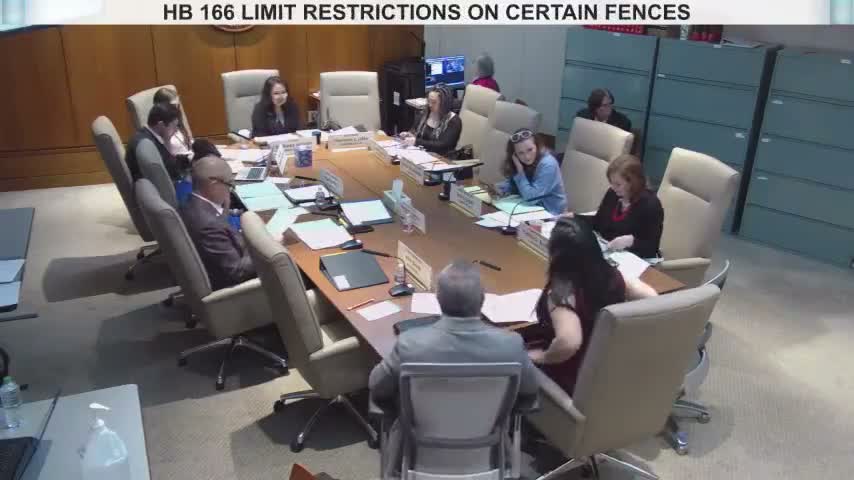
A House committee voted to give House Bill 166 a due pass after proponents said the bill will create consistent permitting for battery‑charged perimeter fences on commercial properties and ease uncertainty that leaves businesses exposed to theft or vandalism.
The sponsor and witnesses said businesses sometimes obtain local permits under planning departments only to find other local codes or departments require different approvals, forcing costly removal or delays. An industry witness said the bill treats battery‑charged defense systems as an outdoor alarm system and creates a statewide permitting path so businesses have predictable standards.
Supporters argued the bill preserves municipal zoning authority while providing a single permitting approach for these specific systems. Jane Jernigan of the New Mexico Utility Contractors Association said the measure "expands security options with no cost to taxpayers and still maintains local ordinances and zoning."
Committee members pushed back on several technical and policy points. Questions included whether the bill restricts local zoning (sponsors said zoning remains local and the bill targets permitting), whether the statute unfairly prefers battery‑operated systems over plug‑in or solar designs, homeowner association authority in mixed‑use areas, and whether the bill allows fences that exceed local height limits (a member noted Albuquerque allows six‑foot fences; language in the bill may permit higher electric fences under certain clauses).
An expert witness said the bill follows international IEC standards for battery systems and that battery power ensures continuity if utility power fails. Representative Luhan said she voted to advance the bill but asked the sponsor to work with local government planning experts before floor consideration.
The motion for a due pass carried on a roll call announced as four in the affirmative and three in the negative; committee members recorded explanations for their votes on the record.