Lawmakers probe "water's edge" tax election as experts debate revenue, risk and fairness
Loading...
Summary
A joint Senate–Assembly hearing explored whether California should limit or repeal the 40‑year‑old "water's edge" election that excludes many foreign subsidiaries from corporate tax reporting; witnesses gave competing estimates on revenue gains, warned of administrative and litigation risks, and labor groups urged closing the election to protect services.
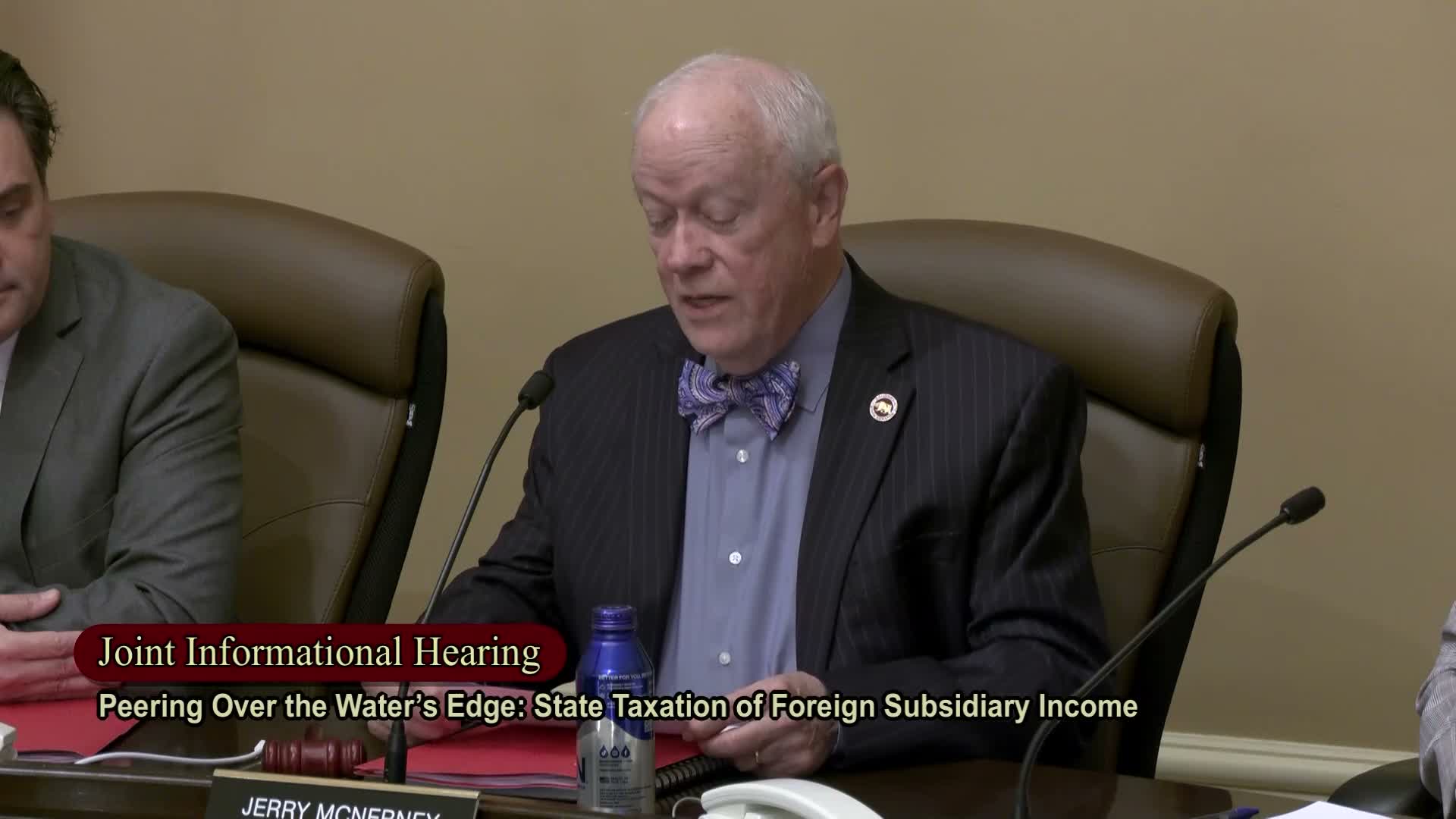
Senate and Assembly revenue and tax committee leaders convened a joint informational hearing this morning to examine whether California should change the "water's edge" election that allows some corporations to exclude many foreign subsidiaries from the state corporate tax base.
The question before lawmakers was twofold: could California raise substantial revenue by requiring broader inclusion of foreign income, and if so, at what cost in administration, litigation risk and economic side effects? Witnesses from the Legislative Analyst's Office (LAO), the Franchise Tax Board (FTB), academic advisers, business groups and labor organizations offered sharply different answers.
LAO economist Rowan Isaac said the policy tradeoffs are real and data are limited. Isaac explained unitary taxation and apportionment — the legal and accounting framework states use to decide how much of a multinational's global income is taxable in California — and warned that firm‑level foreign income is often unobservable. "Low single‑digit billions of dollars is probably about as precise as we're willing to be here right now," Isaac told the committee when asked about possible revenue gains.
Officials from the Franchise Tax Board presented filing data showing the concentration of corporate liability. John McMahon, the FTB's chief economist, said the board received about 21,562 Form 100W (water's edge) returns for 2023 compared with roughly 337,000 worldwide filers, and that water's edge filers — roughly 6% of C‑corporation filers — account for about half of corporate tax liability in California. Jennifer Barton, FTB legislative services director, walked members through technical rules for making and terminating the seven‑year (84‑month) water's edge election and gave a numeric example showing how excluding foreign income can reduce reported group income in a given fact pattern.
An academic witness argued the state's losses from profit‑shifting are substantial. "If you take these IRS numbers ... you get about a $4,000,000,000 increase if we eliminated income shifting altogether," said a professor testifying to the panel, citing cross‑national and IRS studies as supporting evidence. He recommended options including mandatory worldwide combined reporting for large taxpayers or piggybacking on federal provisions such as GILTI (now often described as net CFC tested income) and other anti‑abuse rules.
Business and tax practitioners cautioned lawmakers about practical and legal limits. Jared Walczak of the California Tax Foundation, Dan Kostenbatter of the Silicon Valley Leadership Group and representatives of the Council on State Taxation highlighted compliance challenges, the risk of double taxation under overlapping international regimes, and the potential for protracted litigation — especially where foreign accounting, privacy rules or trade secrets limit the information available to California auditors. Several witnesses pointed to the 1980s history when international pressure contributed to the adoption of water's edge rules and urged caution about reintroducing similar frictions.
Policy and labor witnesses framed the debate as one of fairness and fiscal necessity. Kayla Kitson of the California Budget & Policy Center and labor leaders from SEIU and teachers' unions said that closing the gap in how foreign profits are treated would level the playing field for smaller domestic businesses and could yield funding for health care, education and other services amid projected state budget shortfalls.
Public commenters, many of them educators and caregivers, urged the committees to act. Speakers repeatedly cited multi‑billion‑dollar revenue estimates and said tax changes should be used to shore up schools, health care and social services. One public speaker contrasted teacher tax burdens with reported corporate tax outcomes in a short exchange during comment.
The committee did not take any votes or adopt policy at the hearing. Members pressed witnesses for more precise revenue modeling, asked how the FTB would administer any change and discussed transition timelines; witnesses suggested transition periods ranging from two to seven years depending on design choices. Chairs said staff and consultants will continue to analyze the tradeoffs as the Legislature considers options.
The hearing record includes detailed LAO and FTB analyses, academic estimates and extensive public comment; the committee adjourned without immediate action and signaled further study and follow‑up would inform any legislative proposals.