Arizona committee advances bill to penalize ‘faithless’ Article V convention delegates
Loading...
Summary
The House Federalism, Military Affairs and Elections Committee recommended HB2908, which would require Article V convention delegates to take an oath, authorize criminal penalties for unfaithful voting, and direct the legislature and governor to ratify approved amendments; the committee gave the bill a 5–2 do-pass recommendation.
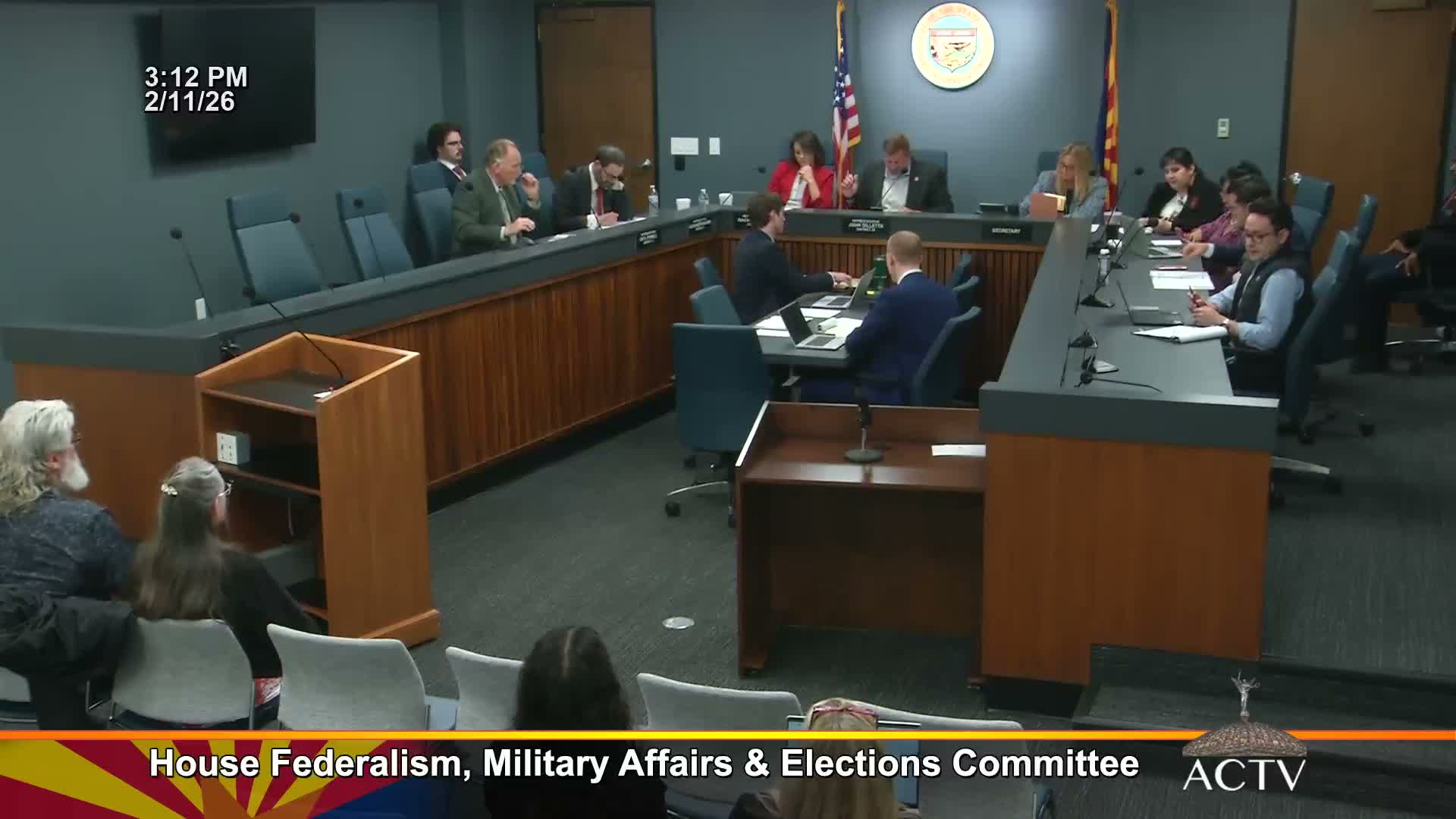
The Arizona House Committee on Federalism, Military Affairs and Elections advanced legislation on Feb. 9 that would impose criminal penalties on Article V convention delegates who vote outside the scope of a state’s call.
HB2908 requires delegates to take an oath before accepting appointment and directs that any constitutional amendment approved at a convention be ratified through the state’s ordinary legislative process — majority votes of both chambers and the governor’s signature — rather than by an alternative state procedure. The committee voted 5–2 to return the bill with a do-pass recommendation.
Supporters presented the measure as a set of “guardrails” designed to limit the risk of a convention acting beyond the state’s intent. The bill sponsor said, “if there is a convention, it’s better to have guardrails than to not have guardrails,” and proposed applying Arizona’s normal legislative ratification steps to any amendment coming out of a convention.
Opponents, including Natalia Brown of Common Cause Arizona, told the committee that statutory penalties would not reliably prevent a so-called runaway convention. Brown said, “A bill that, if passed, would have no merit on what happens should an Article V convention stray from the legal convention scope,” and argued that complex packages could be bundled into a single final vote that would make enforcement and retrospective punishment ineffective.
Committee members debated whether criminal penalties would be enforceable in practice and whether votes cast in convention could be nullified; witnesses and members agreed that votes, once cast, would count and that proving criminal intent after the fact would be difficult. The committee’s action was to recommend HB2908 be returned with a do-pass recommendation; the chair announced the vote as 5 ayes and 2 nays.