
Eastside trustees direct staff to study district‑office staffing and contracts amid steep reserve drawdown
Get AI-powered insights, summaries, and transcripts
Subscribe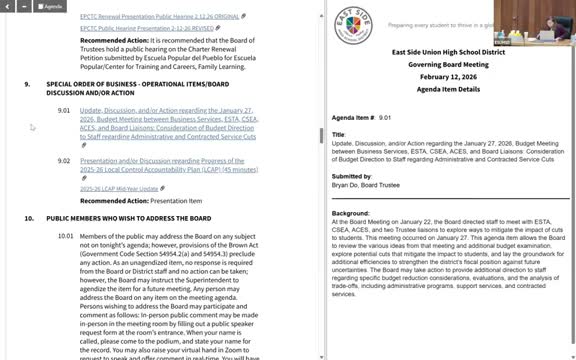
Summary
Trustees asked administration to return with concrete options to reduce recurring costs after hearing public outcry over proposed site staff layoffs; board directed two trustee liaisons to work with staff and bargaining leaders to evaluate district‑office staffing, contracts and technological efficiencies and present options before March deadlines.
Following hours of public comment and trustee discussion at the Feb. 12 meeting, the Eastside Union High School District board directed staff to develop concrete options to reduce recurring, permanent expenditures while prioritizing protections for direct student services.
Trustee Brian Do opened the budget discussion by summarizing the financial challenge: declining enrollment over two decades and a roughly $40 million reduction in district reserves, which he said requires “unpleasant and painful cuts.” He proposed a starting target for discussion of $2 million in recurring budget reductions focused on non‑instructional contractor services, district‑office administrative staffing and technology efficiencies.
Administrators and other trustees said the district has already taken steps — a parcel tax, a staff early‑retirement program (SERP) and prior targeted reductions — to preserve school‑site services. Superintendent Glenn Vanderzee and the district’s business office described an ongoing process for identifying contract and operational savings but said staff needs clear board direction and time to return options that would not create new legal or operational risk.
A broad public turnout pressed the board to protect site‑based student supports such as counselors, social workers, advisers, campus monitors and the PIECES family‑engagement role. Union and parent speakers argued that cuts concentrated at schools would harm students, and urged the board to prioritize administrative and contract reductions instead.
After extended debate about scope and timing, trustees agreed on a motion to have two trustee liaisons continue meeting with administration and bargaining‑unit leadership to explore district‑office positions, contracts, operations and other potential savings and return options for the full board to evaluate. Board members emphasized the process should provide a shared baseline of data, identify plausible options that can be implemented before statutory timelines (including March 15 personnel‑notice deadlines), and include trade‑off analyses that protect direct student‑facing services where possible.
Separately, the board approved a staff recommendation that will reclassify a service position (educationally related mental health) so that existing social workers may apply, an administrative step designed to preserve employees while retaining targeted savings from planned reductions. The board approved other consent and bond‑related procurement items before adjourning.
The board’s directive does not itself enact layoffs; it requires administration to return with specific, implementable options for recurring savings and proposed mitigations for student‑facing impacts.