
Consultant presents two rate scenarios to fund San Juan’s $97 million water and wastewater plan
Get AI-powered insights, summaries, and transcripts
Subscribe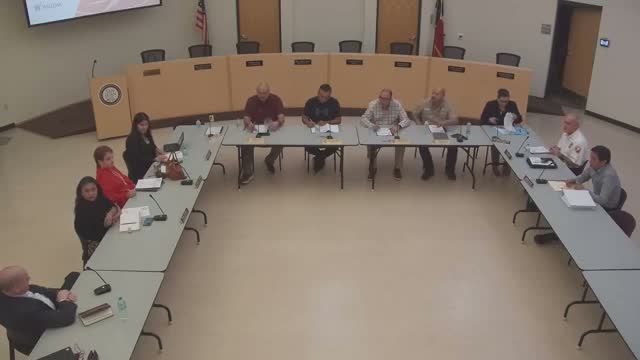
Summary
Willdan Financial Services presented two scenarios to fund $97 million in water and wastewater capital projects for San Juan, showing steeper near‑term rate increases under a 100% debt plan and lower increases if about half the CIP is funded through other sources; a commission workshop was requested.
A consultant told the San Juan commission that paying for roughly $97 million of identified water and wastewater capital projects will require multi‑year rate increases unless the city secures grants or scales back projects.
Jason Gray, vice president of Willdan Financial Services, outlined two modeled alternatives: a 100% debt‑funded plan and a roughly 50% debt plan. Gray said the water master plan includes about $62 million of water projects and the combined CIP approaches $97 million over the next 10 years, and the two scenarios differ mainly in how much capital is financed with long‑term debt versus left for grants or delay.
Gray described the 100% debt scenario as assuming 30‑year level‑payment debt at 4% interest. In that model, water rates would need about 16% increases per year for four years and wastewater roughly 11% for three years (tapering thereafter) to fund all projects. Under the 50% scenario, initial increases are smaller (roughly 12% on water for four years and about 8% on wastewater for three years), and the plan uses fund balance draws to smooth first‑year impacts.
He provided specific bill impacts to illustrate the household effect: a typical 5,000‑gallon residential customer would see combined water and wastewater charges rise by roughly $4–$5 per month (about a 13–14% bill increase) under the 100% plan; a 10,000‑gallon user would see a slightly larger dollar increase. Gray also modeled base‑charge changes: the residential base of $12.05 for a 3/4‑inch meter would rise to $13.98 on the first step and to about $16.21 in successive modeled increases under a 16% step scenario.
On customer counts and growth, Gray said the system now serves about 7,700 water accounts and 7,200 wastewater accounts, and his forecast assumes roughly 150 new water accounts and 148 new wastewater accounts per year (to about 9,000 accounts over 10 years). He cautioned that replacing aging meters or installing smart meters typically shows more accurate consumption and can raise bills initially because meters read previously unrecorded flow.
Gray recommended examining commercial and industrial charges: commercial customers represent about 20% of use but may currently pay less than their share of the cost, shifting burdens to residential customers. He said structural changes to meter charges or tiers for commercial accounts could shave several percentage points off residential impacts but would change how costs are distributed among customers.
The consultant also described how state grant programs can condition funding on a utility’s rate capacity to repay loans. Gray recounted a recent Texas Water Development Board example where the board required an initial ~20% rate increase before awarding about $25 million in combined grant/loan funds.
Commissioners asked for additional detail and for Willdan to work with staff on alternatives that could be more targeted to commercial customers or that examine bill impacts by household income; Gray said the income impact analysis had not been done for this initial presentation but could be requested. Commissioners agreed to schedule a workshop with staff and the consultant to narrow options and provide guidance on what the community could absorb financially.
The meeting adjourned after procedural motion.