Get Full Government Meeting Transcripts, Videos, & Alerts Forever!
Get email alerts on the Community Programs Education Mental Health topic
No spam. Unsubscribe anytime.
San Juan hears presentations on adult diploma program, a Hogg Foundation mental‑health grant and disability services
Summary
Nonprofits told the San Juan commission about an adult high‑school diploma program, a five‑year Hogg Foundation mental‑health grant for a San Juan wellness alliance, and new Valley Association for Independent Living services available to the community.
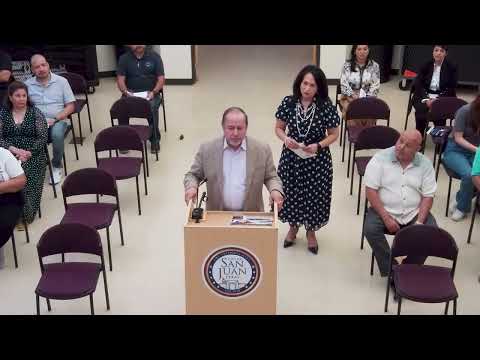
Nonprofit leaders and education staff used the Feb. 11 San Juan City Commission meeting to outline programs aimed at adult education, mental health and disability supports.
Daniel King, founder and board president of the Possible Dream Foundation, said the TEA‑chartered adult high school opened in August and serves people ages 18–50 across three sites with about 380 students enrolled. King emphasized the program issues a regular high‑school diploma (not a GED), provides industry certification and job placement help, operates morning, afternoon and evening four‑hour sessions and offers support for childcare and transportation barriers. King said the program expects roughly 120 graduates by year’s end and asked the commission to help publicize local offerings.
A superintendent connected with the program told the commission the school recorded a 92% passing rate among recent retesters, a statistic presenters described as an early measure of success.
Representatives from the Boys & Girls Club described an awarded Hogg Foundation for Mental Health grant that will seed a five‑year San Juan Youth and Family Wellness Alliance. Rocio Mata, a community social worker contracted to coordinate the initiative, said the work will be community driven: staff will map assets, hold public forums to collect priorities, and teach agencies how to write grants and build sustainable collaborations so the interventions continue after five years. Mata invited residents to a public forum scheduled for the following day and emphasized partner coordination, including Boys & Girls Club mental‑health clinicians and other local nonprofits.
Jorge Villareal, outreach coordinator for the Valley Association for Independent Living (VAIL), described services now available from a recently established Alamo office, including transition programs, employment readiness, deaf services, mobility management, assistive‑technology demos and veteran‑directed care. Villareal said VAIL can partner with San Juan on mobility management and other accessibility initiatives and that services are available in English, Spanish and sign languages.
Commissioners asked practical questions about staffing, program hours and outreach; presenters provided enrollment figures, staffing counts and described free services and next steps for engagement.
What’s next: presenters asked the commission to help spread information to residents and to consider partnering on internships, advertising on utility bills and supporting public‑forum attendance.