
Richmond Community Schools committee agrees to send multiple policy updates to first reading, schedules March policy meeting
Get AI-powered insights, summaries, and transcripts
Subscribe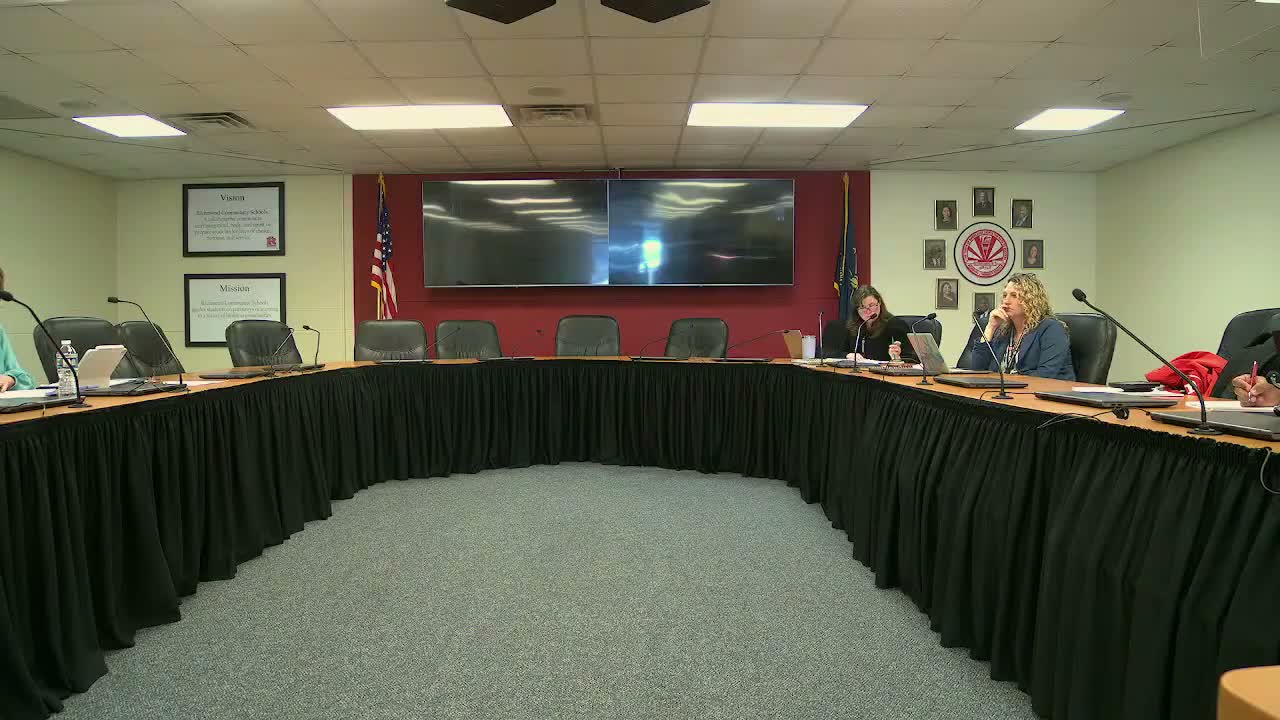
Summary
A Richmond Community Schools policy committee reviewed technical revisions to multiple policies — including course retake rules, background checks for contractors, staff outside-activity limits and board compensation language — and agreed to send several items to first reading and to meet March 10 ahead of the March 18 board meeting.
Richmond Community Schools — The district's policy review committee on Monday examined revisions to several existing policies and agreed to send multiple items to a first reading, scheduling a policy meeting March 10 to prepare for the March 18 board meeting.
The committee discussed revisions to the district's course-retake policy (referred to in the meeting as policy 54 62). Speaker 2, the staff member leading the policy review, said the high school and Mr. Pritcher recommended selecting drafting options a, b, c, d and e in the first drafting section to allow students who earn low grades to retake courses or audit a semester with department approval. "The student receives an an an grade of F in the class," Speaker 2 explained while summarizing the drafting language; the committee agreed the revised retake language should move to first reading in March.
The committee also reviewed personal background-check policy (09/21). Speaker 2 said the district's attorney advised against adopting two drafting notes and recommended instead that the policy reference Indiana Code provisions and require separate board consideration when a contractor or employee has a conviction listed in the statute. Speaker 2 described proposed contract language to require expanded background-check costs to be borne by contractors or subcontractors where feasible and to require contractors to notify the district within two business days if an arrest or charges arise while under contract.
On board compensation (policy 0144.1), Speaker 2 summarized a statutory option that would allow the board to set member compensation up to 10% of the district's lowest starting teacher salary. The transcript contains a discussion tying 10% to a stipend of $4,600; committee members noted the board could instead pass a resolution to retain the existing $2,000 stipend. Several members agreed the decision and any resolution should be considered at first reading so the full board can weigh whether to keep the $2,000 stipend or adopt the statutory option.
Other items the committee cleared for first reading included policy 3231 (outside activities of staff), which adds a prohibition on charging parents for remedial tutoring of students currently enrolled in a staff member's class in that subject. Speaker 2 said this change is intended to ensure that tiered supports provided in school remain available without additional parent fees.
Speaker 3 requested more time to review policy 8500 (free service program) to ensure alignment with U.S. Department of Education and USDA protocols after staffing changes; Speaker 2 said policy 8500 and the proposal on drug and alcohol testing for safety-sensitive roles (policy 41 62) will return in March after additional attorney review.
The committee settled routine reimbursement language (mileage, materials, voucher submission and a 30-day receipts rule) and left in a prohibition on entertainment and alcoholic-beverage reimbursements. Members discussed offering a corporate vehicle for travel and reimbursing mileage when the vehicle is not used.
Next steps: the committee will meet March 10 at 4 p.m. to finalize policies for the March 18 board meeting. No formal votes on policy adoptions were recorded during the meeting; committee direction largely consisted of referrals to first reading and requests for additional legal review.
Attributions in this report use the speaker labels that appear in the meeting transcript. Quotations and paraphrases come only from those speakers' recorded remarks.