Get Full Government Meeting Transcripts, Videos, & Alerts Forever!
Get email alerts on the Police Budget topic
No spam. Unsubscribe anytime.
Franklin Police ask for 12 FY27 budget enhancements including three officers, training sergeant and wellness program
Summary
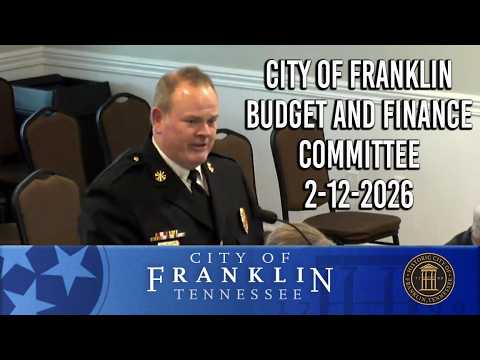
At the Feb. 12 Franklin Budget & Finance Committee meeting, Police Chief Faulkner presented 12 proposed FY27 program enhancements including hiring three officers, creating a training sergeant position, replacing radios and SWAT headsets, adding an evidence technician and launching a Sigma Tactical wellness program; the items are under review and no formal appropriation was taken.
Chief Faulkner told the Franklin Budget & Finance Committee on Feb. 12 that the Police Department is seeking 12 program enhancements for FY27 to keep pace with rising service demands and accreditation standards. He said officers responded to 74,035 incidents last year, “that’s almost 10,000 more calls than the previous year,” and that the department made 1,366 arrests. The presentation included a proposed organizational chart, a five‑year performance summary and a base budget request.
The enhancements range from personnel to equipment. Faulkner outlined requests to add three police officer positions and a training sergeant to oversee defensive tactics, firearms and scenario‑based training, saying well‑trained officers reduce liability and improve performance. He proposed portable radios for new hires, upgraded SWAT communications, an additional evidence technician (the department currently has one), crime‑scene technician equipment for six officers, and a high‑performance crash‑reconstruction computer for the traffic unit.
Other items included traffic‑management software (to provide rapid speed/volume/collision data), a $10/hour increase in extra‑duty pay for event assignments (the extra‑duty rate had not been increased in four years), a drone storage/charging box for patrol deployment, replacement of an 18‑year‑old negotiator vehicle, and a Sigma Tactical Wellness program offering physical evaluations, nutrition counseling and individualized health reports for sworn personnel. Faulkner noted the department worked 14,534 extra hours for events last year and said the wellness program was prompted in part by recent cardiac events among officers.
Committee members asked for cost breakouts and documentation; staff pointed to summary and detail sheets in the packet (PERs and slides). On calls for service, members pressed whether the 15% increase in activity signaled worsening crime. Faulkner and city staff clarified that many calls are noncriminal service or welfare checks; he emphasized that while activity counts rose, “your most serious crimes, we actually saw a decrease” and that an increase in calls does not necessarily equate to more criminal activity.
Faulkner also described the confidential drug fund (established by state law), which the department uses under strict guidelines; the fund is sourced from forfeitures and fines and the department reported keeping the fund status quo in the proposed budget.
No formal votes on the department’s enhancements were held at the meeting; the presentation was part of the multi‑meeting budget review process. Staff and department leaders said further detail and refined cost numbers will be provided as the committee considers FY27 appropriations.
The committee will hear additional department budget presentations at subsequent meetings; the next session of committee business is scheduled for Feb. 19 at 3 p.m.