Experts urge training and transparency as probabilistic forensic reports reach juries
Loading...
Summary
Panelists and practitioners said juror comprehension and examiner education must be priorities as forensic labs adopt probabilistic reporting; they recommended demonstratives, databases, accreditation, and outreach to prosecutors and defense counsel.
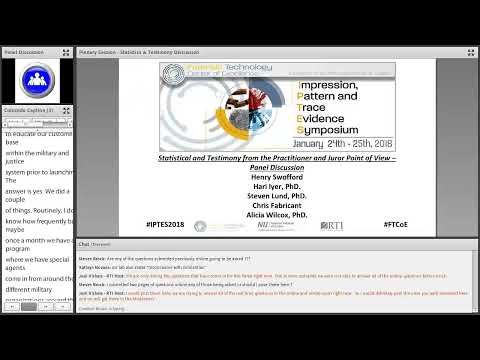
Panelists and practitioners at a technical session on probabilistic forensic reporting underlined that successful adoption of likelihood-ratio reporting depends on educating jurors, litigators, and practitioners.
Jessica, a trace-evidence examiner who identified herself as "from the Pennsylvania State Police," asked how to raise jurors' perception of trace-evidence reliability beyond mere familiarity. She also asked whether laboratories should fund advanced degrees or rely on training and certification. "Do you think that is something that employers should invest in to increase the reliability or do you think they can counteract it by, for example, training and certifications?" she asked.
Alicia, a researcher who collected demographic data in juror interviews, said expanding databases for trace evidence and designing clear courtroom demonstrations could strengthen juror confidence. She advocated for education and professional certification: "I think the more science somebody has, the more critical thinking skills they have ... If I was in a position as a crime lab director, I would certainly put weight on that," she said. The panel also discussed continued practitioner outreach: special-agent laboratory training and trial-counsel sessions were cited as ways labs have engaged prosecutors and defense counsel prior to FR Stat launch.
Nora Rudin, who said she has testified about probabilistic approaches for years, warned that no single model is "the right answer" and urged research comparing the spread of model outputs so that different models produce similar inferences. "It's not the number that you get out ... it's the inference from that LR," she said, recommending that experts focus on communicating the weight of evidence in simple terms rather than the mathematics.
Panelists recommended several practical steps: continued SALT/TCAP/DCAP outreach to justice partners, creation and use of larger reference databases for trace evidence, demonstrative aids in court, and education pathways (advanced degrees or structured training/certification). They also urged labs to be transparent about what their models do and do not include to reduce vulnerability to cross-examination.
The session did not produce formal policy mandates. Instead, participants called for coordinated research on model convergence, expanded training programs, and community-level follow-up workshops (some postponed because of a government shutdown) to help practitioners adopt probabilistic reporting responsibly and in ways juries can understand.