Get Full Government Meeting Transcripts, Videos, & Alerts Forever!
Get email alerts on the Confirmation Bias Forensics topic
No spam. Unsubscribe anytime.
Research team finds preliminary evidence that prior examiner conclusions and expert status affect lay shoe-print match decisions
Summary
A presenter described an analog lab study using 20 shoe-print stimuli that found student participants were more accurate on matches than non-matches and that knowing a prior examiner's conclusion — and whether that examiner was an expert — influenced lay reviewers' responses; results are preliminary and the researchers plan field replication.
Unidentified Speaker (Presenter) outlined an analog lab study developed with the Miami Dade Police Department Forensic Services Bureau exploring whether knowledge of a prior examiner's decision and the prior examiner's expertise influence shoe-print match judgments.
The presenter said the study used 20 footwear impressions (10 matches, 10 non-matches) drawn from materials the police bureau uses to screen applicants and that student volunteers saw each pair and judged whether the prints were a match, a non-match or inconclusive. Participants also rated confidence and difficulty on a 1-to-7 scale.
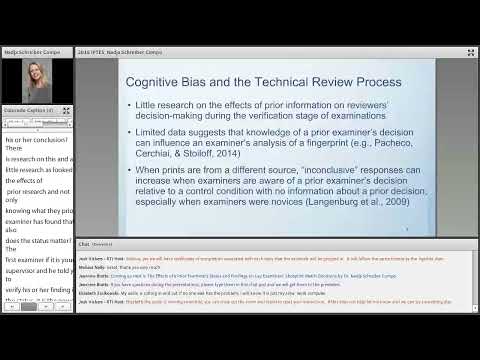
The research matters because forensic-science errors have contributed to wrongful convictions, the presenter said, citing the National Registry of Exonerations and recommendations by the National Academy of Sciences (2009) urging attention to cognitive-bias risks in forensic work. "The knowledge of a prior examiner's decision can influence an examiner's analysis of a fingerprint," the presenter said when summarizing prior lab findings that motivated the current experiment.
In the lab paradigm, participants were randomly assigned to conditions that varied (1) whether they were told the prior examiner found a match, a non-match, an inconclusive result or were given no prior information, and (2) whether the prior examiner was described as a forensic expert, a student or unspecified. The presenter said stimuli were piloted for difficulty over several months to select medium-difficulty items appropriate for novice evaluators.
Preliminary results, the presenter reported, showed participants were more accurate when assessing matching shoe prints than non-matches. For non-match items, what participants were told about the prior examiner's conclusion affected accuracy: being told the prior decision was a non-match led to better performance than being told it was a match. The presenter also reported that when the prior examiner was described as an expert, participants made more inconclusive judgments in some match conditions compared with when no prior information was provided. The presenter cautioned several times that these data are preliminary and that some trends were near a p value of 0.09.
"This is a promising first set of data," the presenter said, adding that the next step is to replicate the findings in field studies that involve real forensic examiners and fingerprint comparisons. The presenter indicated the research team may seek participation from practicing examiners for follow-up studies.
Details not specified in the presentation include the presenter's name and institutional affiliation, and the final sample sizes and full statistical outputs (the presenter described the December submission as reporting preliminary data and said the overall sample is now larger).