Get Full Government Meeting Transcripts, Videos, & Alerts Forever!
Get email alerts on the Cybersecurity Policy topic
No spam. Unsubscribe anytime.
Easley council debates acceptable-use policy for elected officials and sets executive session on IT security
Summary
Council reviewed a proposed amendment to the Acceptable Use Policy for elected officials that would require acknowledgment and could assign repair costs for malicious damage; members debated personal liability and whether the policy is in employees' handbooks. Council also scheduled an executive session to discuss police IT-security upgrades and devices.
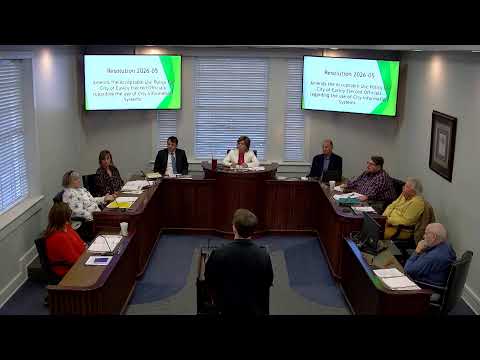
Council considered Resolution 20 26 05, an amendment to the Acceptable Use Policy (AUP) for elected officials that would formalize expectations for use of city information systems and require elected officials to sign an acknowledgement. The proposed amendment, prepared by council counsel at Mister Alexander's direction, would allow the city to allocate costs to officials in some cases where city property is damaged through misuse.
Several council members said they were uncomfortable assigning personal financial responsibility for actions that might be accidental, and asked for clarification about how the policy compares to employee standards. One councilmember asked, "If I were to accidentally open an attachment… would I be responsible for paying for that?" Staff counsel (Jordan) responded that intentional or malicious misuse is treated differently than an inadvertent opening and that the city uses discretion when determining whether cost recovery is appropriate. Jordan also said the AUP recommendation is consistent with guidance from CISA/DHS and is intended to protect the city’s technology assets.
The council discussed enforcement mechanics and whether elected officials who decline to sign would still receive equipment. Counsel said the resolution requires acknowledgement for the record but does not necessarily mean agreement with the policy’s contents; the AUP language would bar access to city technology for officials who refuse the required acknowledgement. Separately, council approved a motion and second to enter an executive session under Section 34-70(a)(3) to discuss police IT security upgrades and security devices; no votes will be taken in executive session, the mayor said.
Next steps: Council may amend the resolution or vote on it in the business meeting. Staff said it will provide clarifying language and referenced that an AUP for employees exists in the employee handbook.