Get Full Government Meeting Transcripts, Videos, & Alerts Forever!
Get email alerts on the Economic Development topic
No spam. Unsubscribe anytime.
Wilsonville planning commission recommends council adopt citywide economic opportunities analysis
Summary
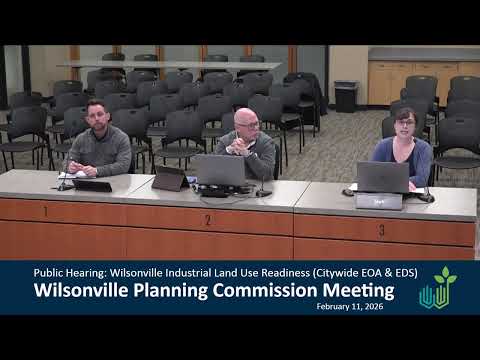
The Planning Commission voted unanimously Feb. 11 to recommend City Council adopt a citywide Economic Opportunities Analysis and accompanying Economic Development Strategy (resolution LP26-0001), finding adequate long-term industrial land but near-term readiness challenges and limited vacant commercial land.
The Wilsonville Planning Commission voted unanimously Feb. 11 to recommend that City Council adopt a citywide Economic Opportunities Analysis (EOA) and an Economic Development Strategy (EDS), a package designed to guide industrial and commercial land planning over the next two decades.
City senior planner Chris Myers and consultants from Eco Northwest presented the analysis during a public hearing. Nicole Underwood, lead consultant, said the EOA is designed to meet Oregon’s statewide land-use planning requirements under Goal 9 and become part of the comprehensive plan’s factual foundation. “An EOA or an economic opportunity analysis is an analysis that meets certain legal requirements in Oregon’s statewide land use planning system under Goal 9,” Underwood said during the presentation.
The consultants reported that Wilsonville had roughly 22,800 covered jobs in 2023 and used regional forecasts from the Oregon Employment Department to estimate future demand. Underwood said the forecast anticipates about 6,100 additional jobs by 2046, which the team translated to an estimated need for about 320 acres of industrial land and roughly 110 acres of commercial land.
The EOA’s key findings, the presentation said, are that the city appears to have enough industrial land in total but faces near-term “readiness” constraints: many industrial parcels are small, fragmented, and lack urban-level infrastructure. For commercial uses, vacant land is limited; however, staff noted there are large vacant buildings (former retail anchors) and about 53 acres identified in a high-level redevelopment analysis that could support commercial reuse in the near term.
Consultant Beth Goodman described the assumptions used in the forecast, including an overall working assumption that about 70% of employment in Wilsonville is covered by unemployment insurance, with the remainder not covered, a figure drawn from county-level patterns the team applied to the city.
Commissioners questioned staff on several points during the hearing, including whether local rail lines or projected airport-area expansion were counted as advantages or potential sources of jobs. Eco Northwest staff said rail can be an asset for a narrow set of freight-intensive industries but that Wilsonville’s parcel sizes and the costs of creating rail spurs limit that advantage; airport-area land was not included in the city’s supply because much of it lies outside city limits and in rural or EFU designations.
The staff recommendation — that the commission adopt resolution LP26-0001 to forward a recommendation to Council — passed after a motion and second. The motion was seconded by Commissioner Rob Candrian and was approved unanimously (vote reported as unanimous by the chair).
Following the vote, staff noted the next step is a City Council public hearing on March 2. The EDS that accompanies the EOA contains 16 actions organized into six focus areas, including industrial readiness, financing mechanisms for redevelopment, reuse of underutilized commercial space, workforce development, and small-business supports; many actions are identified as near-term or as contingent on securing additional funding.
The commission’s discussion and the staff presentation repeatedly emphasized the distinction between discussion (options and constraints) and formal action: adopting the resolution forwards the EOA/EDS to Council for its consideration rather than directly enacting new city spending or zoning changes.
The commission adjourned the public hearing portion after the vote; Council consideration is scheduled for March 2.