Sentencing Guidelines Commission opens study of Minnesota’s 'Hernandizing' rule after staff data shows rising use and dispositional impact
Loading...
Summary
Commission staff and external researchers told the Sentencing Guidelines Commission that the Hernandez 'hernandizing' rule is being used more frequently and that in many cases it moves defendants from presumptive probation to presumptive prison; the commission formed a subcommittee and asked staff for deeper demographic and charging-pattern analyses.
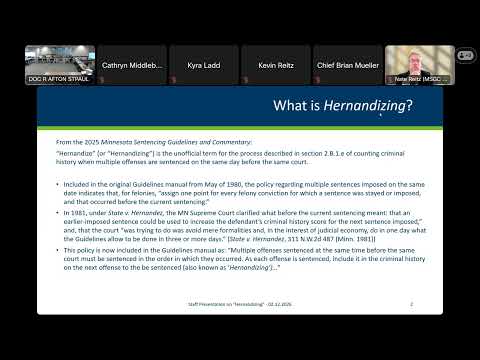
The Minnesota Sentencing Guidelines Commission on Feb. 12 began a detailed review of the Hernandez sentencing rule — informally called "hernandizing" — after staff presented data showing both the number and the share of sentences using the rule have increased over the last two decades.
The matter matters because hernandizing can raise a defendant’s criminal-history score in a single sentencing event, sometimes moving a case from a presumptive stay of execution to presumptive commitment. "The percentage of all cases that are being hernandized has increased from about just under 20 percent back in 2001 to over 25 percent now," staff analyst Matt Hilna said during the meeting.
Why the commission is studying it
The review began with an explanation from Linda McBrayer of how the rule works and its two statutory exceptions: a single-course-of-conduct exception and a multiple-victims exception. "So what the Hernandez case did was explain what before meant," McBrayer said, describing how the rule causes one imposed sentence to be counted as prior history for another when multiple offenses are sentenced at the same hearing.
Professor Daniel Reitz (law school researcher) told the commission the rule is uncommon in other guideline systems and that its effects in Minnesota are pronounced. "I'm certain in my own mind that the Hernandez rule has a significant impact on Minnesota's prison population, and rate and almost certainly contributes to racial disparities," Reitz said, summarizing his team's comparative review and earlier work.
A single case illustration
Reitz illustrated the rule’s potential effect with State v. Bakken, a reported Minnesota Supreme Court case involving seven counts of possession of child sexual-abuse material. Under hernandizing, Reitz said, "the seventh count now has a presumptive prison term of 51 to 60 months." He contrasted that with a concurrent-count approach: "If we were to look at concurrent sentences without the Hernandez rule... all counts 1 through 7 with a criminal history score of 0 would have a presumptive sentence of 15 months." The example was offered to show how counting multiple current convictions as prior history can dramatically change presumptive outcomes.
Data and open questions
Staff presented several empirical findings: an increase in both the raw number of hernandized cases and the percent of all sentences that are hernandized; a post-2020 spike likely related to COVID-era backlog that later declined; and an increase in the number of priors hernandized within individual cases. Staff also identified offense types that frequently appear in hernandized cases (e.g., controlled-substance offenses by count, and certain sex offenses by percent) and showed that Hernandez presumptive commits receive fewer mitigating dispositional departures than comparable non-Hernandez presumptive commits.
Commissioners pressed staff and researchers on open questions the data do not yet answer: how many hernandized cases arise from multiple complaints consolidated for sentencing versus multiple counts in a single complaint; whether rising use is driven by prosecutorial charging strategies or by courts consolidating backlog cases; and the racial-demographic effects of the rule. Data staff explained their person-based counting approach and said the team can look for more granular breakdowns. "I don't know for sure... but I would say the former is my hypothesis," Hilna said of the backlog explanation and offered to follow up with a definitive analysis.
Prosecutorial discretion and case types
Both staff and commissioners discussed how hernandizing interacts with prosecutorial charging decisions. Reitz and other presenters cited prior research showing prosecutors can and do alter charging practices after Hernandez-type rules take effect. Commissioners observed that some offenses — notably many child sexual-abuse-material (CSAM) investigations — often generate large case counts tied to many images or victims, which affects charging strategy. "Prosecutorial discretion to matter that much in a multi count case is entirely dependent on the Hernandez rule," Reitz said.
Next steps
After questions and discussion, the commission appointed a subcommittee to study hernandizing in detail and asked staff and the research team to produce follow-up analyses, including a request for demographic and racial-impact projections similar to recent criminal-history reform work. Commissioners also asked staff to attempt to distinguish single-complaint multi-count cases from multi-complaint consolidated sentencing in the data.
The commission's next procedural step on this topic is the subcommittee review and the staff follow-up analyses, which the commission directed be included in future research-team meetings.