Get Full Government Meeting Transcripts, Videos, & Alerts Forever!
Get email alerts on the Elected Official Salaries topic
No spam. Unsubscribe anytime.
Bloomington council debates values-based plan to raise 2025 elected-official salaries; second reading set for Dec. 11
Summary
At a Dec. 10 special session the Bloomington Common Council heard an ad hoc committee recommend new, values-based 2025 salaries (mayor $151,410; clerk $129,780; council $45,423), examined phasing and percentage-based options, and deferred a final vote to the second reading on Dec. 11 amid strong public reaction and a possible mayoral veto.
The Bloomington Common Council on Dec. 10 spent more than two hours debating Ordinance 2024-26, a committee-drafted proposal to reset 2025 salaries for the city’s elected officials.
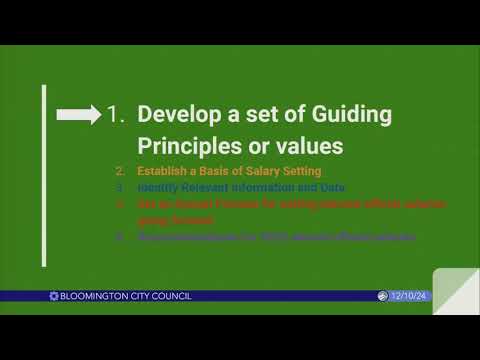
An ad hoc salary committee presented a values-based framework it developed with a Crowe consultant, listing five guiding principles—accessibility of office, equitable pay, quality community service, informed decisions and a transparent documented process—and described a method using an anonymous heat map to rate possible salary bases. "We set out to determine what elected officials should be paid," said Council Member Stosberg, who chaired the committee’s presentation, adding that the group had not looked at numbers until late in the process.
The committee’s recommendation presented dollar figures the committee said flowed from that framework: a mayoral salary at the midpoint of the city’s highest civil pay grade (listed at $151,410 for 2025), a city clerk salary near the midpoint of senior department-head pay (listed at $129,780), and a council member salary of $45,423 (the committee described this as a substantial increase from current pay). "We were trying to correct for inequitable pay," Council Member Rosenberger said.
Several members said the recommended totals produced public 'sticker shock' and asked whether the committee had relied too heavily on internal anchors rather than benchmarking other jurisdictions. "I did not like that final number when it came up," Council Member Stosberg said, describing her own reluctance to forward the proposal but citing the committee’s deliberative process and concerns about historically depressed elected-official pay.
Alternate proposals were discussed. Council Members Daley and Zulek described a phased approach that would implement roughly one-third of the proposed increases in 2025 and spread remaining adjustments through 2028, with example 2025 figures they read aloud that would put the mayor near $142,490.67, the clerk near $101,260 and council members near $24,196 in the first year of a phase-in. Council Member Flaherty and others supported setting council salaries as a percentage of the mayor’s salary (committee discussion centered on endpoints between 20% and 30%), while Council Member Stosberg outlined a separate "wage-gap" calculation that compares past mayor-council pay differentials adjusted for inflation as another way to reduce the historical gap.
Consultant Shannon Madden of Crowe said the firm "was asked to serve as a third party facilitator" and reiterated that Crowe provided facilitation and a summary memorandum but did not direct outcomes. Clerk Bolden and staff provided context on pay grades and on workload in the clerk’s office; Bolden told the council that staffing levels had returned to prior levels while workload had increased.
Public comment was strongly mixed. Some residents and business leaders urged caution and called the increases tone-deaf in a year of rising living costs and property taxes; others supported the framework as a corrective to long-standing inequities and said fair pay would widen the applicant pool for public office. "Just because a committee works hard on a presentation to give themselves raises doesn't mean that you deserve it," said Zoom commenter Renee Miller. Former Council Member Jeff Richardson told the council that perception management would be critical and urged clearer public explanation. Steve Boland and the Greater Bloomington Chamber's Eric Spoonmore voiced differing emphases on fairness and competitiveness in local pay.
The council took two formal procedural actions during the special session: it adopted a motion to structure the night’s discussion and, during public comment, approved a motion to extend individual speakers' time to five minutes with public comment ending at 10:15 p.m.
No final vote on Ordinance 2024-26 occurred at the special session. The Presiding Officer reminded the body that the ordinance will receive a second reading and a vote at the regular session scheduled for Dec. 11, 2024, at 6:30 p.m. The mayor has signaled she is likely to veto salary increases beyond a cost-of-living adjustment, and staff told council members to submit final amendment language by 1:00 p.m. the day before the vote so it can be included in the packet.
What happens next: councilmembers indicated they will continue to negotiate amendments—possible approaches include phased increases, percentage-of-mayor endpoints, different clerk pay grades, or blended math-based models—and staff warned that any veto would require an additional special meeting before year-end to meet statutory deadlines. The committee’s memorandum, Crowe’s summary and the proposed ordinance language are in the public packet for the Dec. 11 meeting.