Get Full Government Meeting Transcripts, Videos, & Alerts Forever!
Get email alerts on the Collective Bargaining And Governance topic
No spam. Unsubscribe anytime.
Bloomington council discusses observing AFSCME bargaining, proposes finance committee and short-term budget task force
Summary
Council attorneys reviewed municipal-code options to let council observe union bargaining; Council Member Zulek volunteered to draft a code change to let council observe AFSCME negotiations. President proposed a four‑person Council Finance Committee and a four‑member Budget Task Force to guide outcome‑based budgeting.
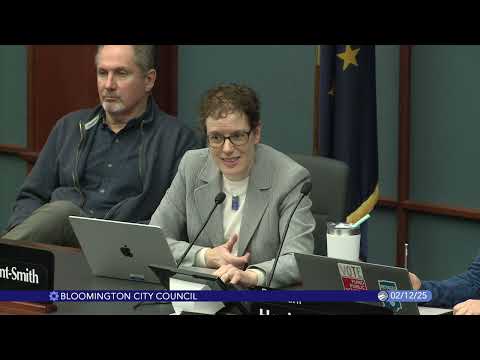
At the Feb. 12 special meeting the Bloomington Common Council discussed whether to expand council observation rights for collective bargaining and considered internal governance changes to improve budget oversight.
Council attorney explained how the Bloomington Municipal Code already allows council observation of police bargaining (section 2.32) and fire bargaining (section 2.34) and said AFSCME bargaining is not currently covered by code language. The attorney noted current collective bargaining agreements for police and fire expire Dec. 31, 2026, and said AFSCME negotiations likely would occur on a similar timetable. "Bloomington Municipal Code section 2.32 controls collective bargaining, between the city and the Fraternal Order of Police," the attorney told the council when outlining the code provisions.
Council members discussed whether the city should add a code provision to allow council members to observe AFSCME sessions (an observation role, not a negotiator role). Council Member Zulek offered to draft the necessary ordinance language: "I'm interested, and I am happy to help draft that legislation to change the code," Zulek said.
Separately, the council president proposed creating a four‑member Council Finance Committee—initially as a special committee that would not require a formal resolution—and a short‑term four‑member Budget Task Force including the Deputy Mayor and the Controller to accelerate work toward outcome‑based budgeting. The Finance Committee would meet at least quarterly, work closely with the controller to build an annual budgeting calendar, track fund balances and recommend topics for full council discussion. The Budget Task Force would be time‑limited and focus on setting goals and frameworks for departments during the transition to outcome‑based budgeting.
The proposal did not prompt immediate volunteer assignments; the president asked council members to submit interest by the coming Sunday so she could appoint members before the next meeting. No formal vote or ordinance was taken at the Feb. 12 meeting; council members said they will revisit the proposals next year and when bargaining timetables near 2026.
Why it matters: multiple municipal collective bargaining agreements are on coincident expiration schedules, which council members said could concentrate negotiation workload and public scrutiny. Allowing council observation or creating internal budget oversight bodies would change how elected officials engage with contract negotiations and budget development.