Get Full Government Meeting Transcripts, Videos, & Alerts Forever!
Get email alerts on the Housing Policy topic
No spam. Unsubscribe anytime.
Council allows Curry PUD to meet workforce-housing commitment with payment to housing fund; debate over long-term value
Summary
On third reading the council approved a Curry PUD amendment allowing the developer to satisfy a 15% workforce-housing commitment through a payment in lieu (52 bedrooms → $1,040,000 at $20,000/bedroom). Council and housing staff debated enforcement, vacancy trends, and how the housing development fund would be used.
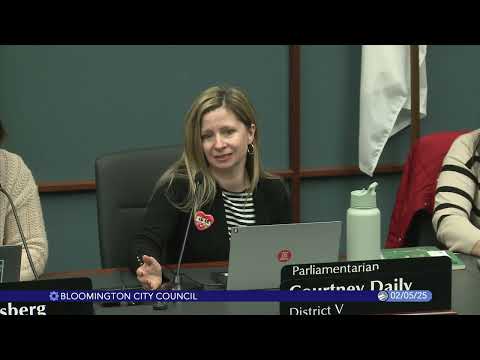
Bloomington Common Council voted on Feb. 5 to amend the Curry planned unit development (the Rolato at 105 S. Pete Ellis Drive) to allow the workforce-housing obligation to be met through a payment to the city’s housing development fund rather than by providing units on-site.
Planning staff said the original zoning commitment required workforce housing equal to 15% of bedrooms (52 bedrooms on this site). Using the administrative manual rate in place at the time ($20,000 per bedroom), the payment in lieu equated to $1,040,000. Planning staff and the petitioner said the property has repeatedly struggled to fill those 52 bedrooms on-site and have worked with the housing department for more than a year.
Anna Killian Hansen, director of Housing & Neighborhood Development (HAND), told council the city faces both short-term and long-term housing problems: several workforce housing projects currently have high vacancy rates and HAND wants flexibility to use money from a payment in lieu for tenant-based rental assistance, eviction prevention, down-payment/closing-cost assistance, and targeted projects with covenants to preserve affordability. HAND said the housing development fund balance is roughly $4,000,000 and that staff has already budgeted approximately $1,000,000 of new programming for 2025.
Petitioner Tom Jason (SPCW Bloomington JV) said the developer reduced target rents and worked with HAND to qualify renters; despite those efforts they had only signed about 25 of the 52 units by December 2024. Several council members argued the long-run present value of 52 committed affordable units could exceed the short-term dollars, urged stronger enforcement language in zoning commitments, or suggested retaining a portion of the units as on-site affordability.
After public comment and an extended round of council questions about enforceability, AMI targeting and alternatives, the ordinance passed on third reading by roll call (recorded outcome: 5 yes, 4 no). The housing department and petitioner indicated the zoning commitment language and payment terms were finalized and would be recorded following council action.
What happens next: The payment will be recorded per the zoning-commitment language; the housing development fund will be available for HAND to allocate toward tenant assistance and other short-term housing programs. Council members signaled interest in revisiting UDO standards and enforcement for future PUDs.