Get Full Government Meeting Transcripts, Videos, & Alerts Forever!
Get email alerts on the Convention Center Expansion topic
No spam. Unsubscribe anytime.
Bloomington council hears $70 million convention center expansion plan, financing via lease bonds and food-and-beverage revenues
Summary
Council received design, schedule and budget briefings on a roughly $70 million expansion of the Bloomington Convention Center, including a plan to fund the work with $50 million in lease rental bonds, $20 million in existing food-and-beverage cash and a prefunded revenue-stabilization reserve; a public hearing on the lease is set for March 5.
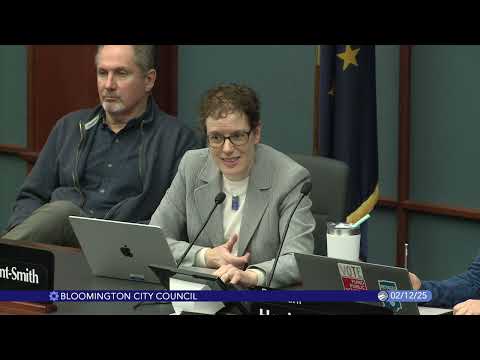
Bloomington Common Council members on Feb. 12 heard detailed designs, schedule and financing plans for a proposed expansion of the Bloomington Convention Center that project leaders said will cost roughly $70 million and could begin construction as early as June 2025.
The council heard architecture and program details from Sarah Hempstead of Schmidt Associates, budget and contingency explanations from CIB staff and consultants, and a financing plan from municipal advisor Buzz Kron that relies on a $50 million lease-rental bond issue supported primarily by city food-and-beverage tax receipts and $20 million of on‑hand food-and-beverage cash.
The project, as described by designers, will add roughly 65,000 square feet including an Exhibit Hall just under 27,000 square feet, flexible partitioned meeting spaces, an elevator and a bridge connector to the existing building. Hempstead said the design targets sustainability (LEED Silver tracking), expanded accessibility, substantial glazing to activate the streetscape, and green‑roof elements; she told the council construction documents should be complete enough to seek bids by July 2025 and that construction could start in June 2025 with final completion targeted for February 2027.
"We're looking at roughly a $70,000,000 project," municipal advisor Buzz Kron told the council, describing a funding package that combines bond proceeds, cash on hand and operating revenues.
How it would be paid: Kron outlined a financing approach that would issue approximately $50 million in lease‑rental bonds, use roughly $20 million of accumulated city food‑and‑beverage (F&B) cash, and prefund a revenue‑stabilization fund of about $3.8 million from that F&B cash at closing. Kron projected current F&B collections average about $4.14 million a year and said, under conservative interest‑rate assumptions, the plan produces a coverage ratio in the low 110 percent range—slightly above the 110 percent target the team used. Kron said the city would include a backup pledge of local economic development income tax (EDIT) for credit enhancement but does not intend to draw on that backup in normal circumstances.
Bond counsel and corporation counsel explained the structure: the city has formed a City of Bloomington Public Building Corporation that will own the project and issue bonds under Indiana Code 36‑1‑10; the city will lease the facility from that corporation and make lease payments funded by pledged F&B revenues. "The city is using the food and beverage tax revenue to pay debt service on the bonds," bond counsel Tenley Drescher Rhodes explained, characterizing the lease as a financing mechanism rather than a conventional tenancy.
Budget and risk: CIB controller Jeff Underwood and consultant Deb Kuntz summarized the scope and a planning budget that shows about $52 million in hard construction costs and additional fees for a total near $70 million; the team said they carry a construction contingency and an external contingency that together approximate 10 percent of construction. Presenters said the delivery method (construction manager at risk) and early contractor involvement help manage price and schedule risk. Council members asked about steel tariffs, delivery logistics to the new loading dock, potential pandemic-like revenue drops and whether union labor would be required; the contractor, Weddell Brothers, confirmed it is signatory to several trade agreements and can self‑perform up to 20 percent of work under the chosen delivery method.
Design details: Schmidt Associates showed program layouts and elevations, noting the new exhibit space will be flexible (banquets ~1,400 seats; roughly 157 exhibit booths) and high enough to meet Indiana High School Athletics Association regulations for certain sports, which designers said expands potential event types. The expansion includes bicycle parking (about 40 spaces), screened loading docks sized for two semis plus a box truck, and opportunities for public art integrated into masonry and limestone banding.
What happens next: counsel said staff will publish the required notice this week and hold a statutorily required public hearing on the lease and preliminary plans at the council meeting on March 5; the council is expected to consider resolutions authorizing the lease and the building‑corporation bond issuance after that hearing. Presenters offered to provide follow‑up answers on truck delivery frequency, detailed green‑roof soil depths and other technical follow‑ups the council requested.
Why it matters: the plan would commit long‑term capital and pledged revenue (food‑and‑beverage tax) to repay bondholders and, under the proposed structure, temporarily convey project ownership to a newly formed building corporation to enable lease financing and avoid the city's constitutional debt limit. Council members pressed for clarity on contingency, operating risk and ownership transfers before a March vote.
The council set a public hearing for March 5 to receive formal public comment on the lease and will revisit the approvals required to proceed with bond issuance and property transfers.