Get Full Government Meeting Transcripts, Videos, & Alerts Forever!
Get email alerts on the Boards And Commissions topic
No spam. Unsubscribe anytime.
Council adopts wide-ranging updates to boards and commissions code after amendments
Summary
The Bloomington Common Council adopted ordinance 2025-05 on Feb. 19, updating duties, names, and reporting requirements for multiple city boards and commissions after passing a staff-backed amendment and rejecting a broader residency change.
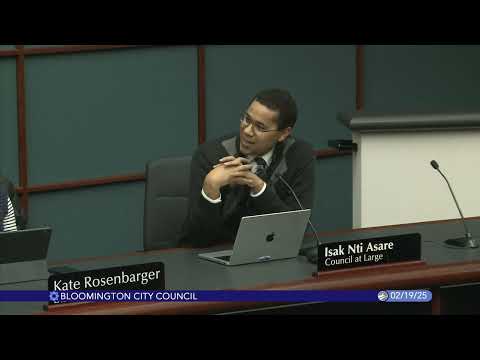
Bloomington — The Common Council on Feb. 19 adopted Ordinance 2025-05, which revises code language for 13 resident boards and commissions and requires regular written annual reports to the mayor and council.
The ordinance, sponsored by Councilmember Stosberg, consolidates and clarifies commission duties and updates several names and meeting rules. "This ordinance comes out of work done by the Special Committee on Council Processes," Stosberg said in presenting the measure, noting the committee used a 2021 Novak Consulting Group review to guide changes and consulted staff liaisons and affected commissions.
A key amendment (Amendment 1) that the council approved clarifies meeting frequency language for the Community Advisory on Public Safety (CAPS), narrows staff support expectations to regular meetings, removes some obsolete duties for commissions that only the executive branch can perform, and expands residency eligibility for two commissions (Status of Children and Youth; Status of Women) to Monroe County to widen the applicant pool. Jennifer Crossley, deputy clerk for communications and outreach, told the council the residency change would allow the city to "obtain and keep those quality candidates" who otherwise would be excluded.
Council rejected Amendment 2, a broader proposal to allow county residents or anyone whose primary employment is in the city to serve on commissions. Supporters said it would enlarge the candidate pool; opponents raised concerns about verification and the significance of city residency. The roll-call vote on Amendment 2 failed (three in favor, five opposed).
Council members emphasized that changes were vetted with staff liaisons. Piedmont Smith, sponsor of several prior code changes, said she "communicated with the staff liaisons and they communicated with the commissions," and added the environmental commission’s adjusted duties reflected legal limits on what a commission may do.
Votes at a glance: - Ordinance 2025-05 (as amended): Adopted by roll call, unanimous in the transcript record. - Amendment 1: Adopted (technical and procedural changes, residency expansion for two commissions). - Amendment 2: Failed (proposed broad residency/employment eligibility expansion).
What happens next: The ordinance updates will take effect according to the timetable in the code; the council also approved Resolution 2025-02 to refresh interview committee assignments and create an administrative path to reassign interview duties without a new resolution each time.
Why it matters: Council members said the changes aim to make boards and commissions more effective and transparent by (1) removing obsolete or legally inappropriate duties, (2) standardizing annual reporting, and (3) improving recruitment when seats went unfilled.
The meeting record shows outreach from affected commissions: Justin Vassell, chair of the Commission on Sustainability, told the council the commission "support[s] the changes in section 2.1201" and had provided input during the drafting process. The council also reappointed two sustainability commissioners during the meeting.