
Senate panel advances Second Amendment Preservation Act amendments after law‑enforcement concerns
Get AI-powered insights, summaries, and transcripts
Subscribe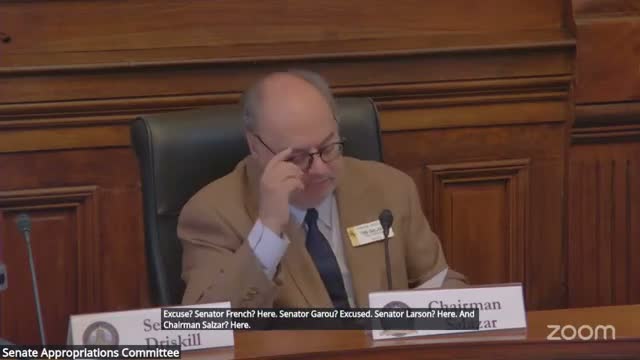
Summary
The Senate Appropriations Committee voted 5‑0 to report Senate File 101, amendments to the Second Amendment Preservation Act, after debate on civil‑penalty language and exemptions for federal task‑force cooperation; the sponsor pledged to work with law enforcement on drafting fixes.
The Senate Appropriations Committee on Monday advanced Senate File 101, amendments to the Second Amendment Preservation Act, after hearing testimony from law‑enforcement leaders who warned the changes could complicate cooperation with federal task forces. The committee voted 5‑0 to report the bill out with a drafting amendment.
Sponsor remarks and bill scope: The bill’s sponsor told the committee the amendments close gaps in last year’s law by adding civil penalties against agencies and clarifying that Wyoming funds and officers should not be used to enforce federal gun‑control laws. “It puts critical civil penalties into the law that let individual gun owners defend their rights in the event of a violation,” the sponsor said, and emphasized the draft does not allow individual officers to be sued.
Why it matters: Supporters said the bill protects state sovereignty over law enforcement and prevents federal agencies from deputizing Wyoming officers to enforce federal gun regulations. Opponents, including the Wyoming Association of Sheriffs and Chiefs of Police and senior state law‑enforcement officials, warned the statutory language is vague and could heighten liability exposure for agencies and create operational gaps in federal‑state task forces.
Law‑enforcement concerns: Alan Thompson, executive director of the Wyoming Association of Sheriffs and Chiefs of Police, said sheriffs and chiefs are worried about vagueness in the bill and the increased liability that task‑force participation could trigger. “We are concerned with the impact of this law, in the vagueness of some of the wording,” Thompson said. Lieutenant Colonel Carl Germaine of the Wyoming Highway Patrol testified that the bill, as drafted, could limit participation in federal task forces including ICE 287(g), the U.S. Marshals and Bureau of Indian Affairs task forces, hindering arrests in some jurisdictions.
Operational risk and civil penalties: Ronnie Jones, director of the Division of Criminal Investigation, told the committee DCI assigns agents to federal task forces and that partnerships produced dozens of federal prosecutions last year. He warned that added civil penalties and agency exposure — testified as $50,000 per violation during testimony — would force the division to weigh federal cooperation against new legal and financial risks.
Sponsor response and next steps: The sponsor said he wants specific, line‑by‑line feedback from law‑enforcement partners and LSO to fix drafting errors and offered a drafting relocation amendment during the hearing. The committee adopted that amendment. The sponsor pledged to continue working with law‑enforcement partners and the legislative staff on technical clarifications.
Outcome: The committee recorded five ayes on the roll call and reported Senate File 101 'do pass' from appropriations. The bill’s sponsor will circulate targeted amendments to address the drafting and exemption concerns raised in testimony.
What’s next: The bill will move to the full Senate for further consideration. Committee discussion and the sponsor’s pledge to work with law enforcement leave open the possibility of additional technical amendments on the floor.