
Habitat Council backs expanded beaver restoration, funds new Northeast quarantine and training program
Get AI-powered insights, summaries, and transcripts
Sign Up Free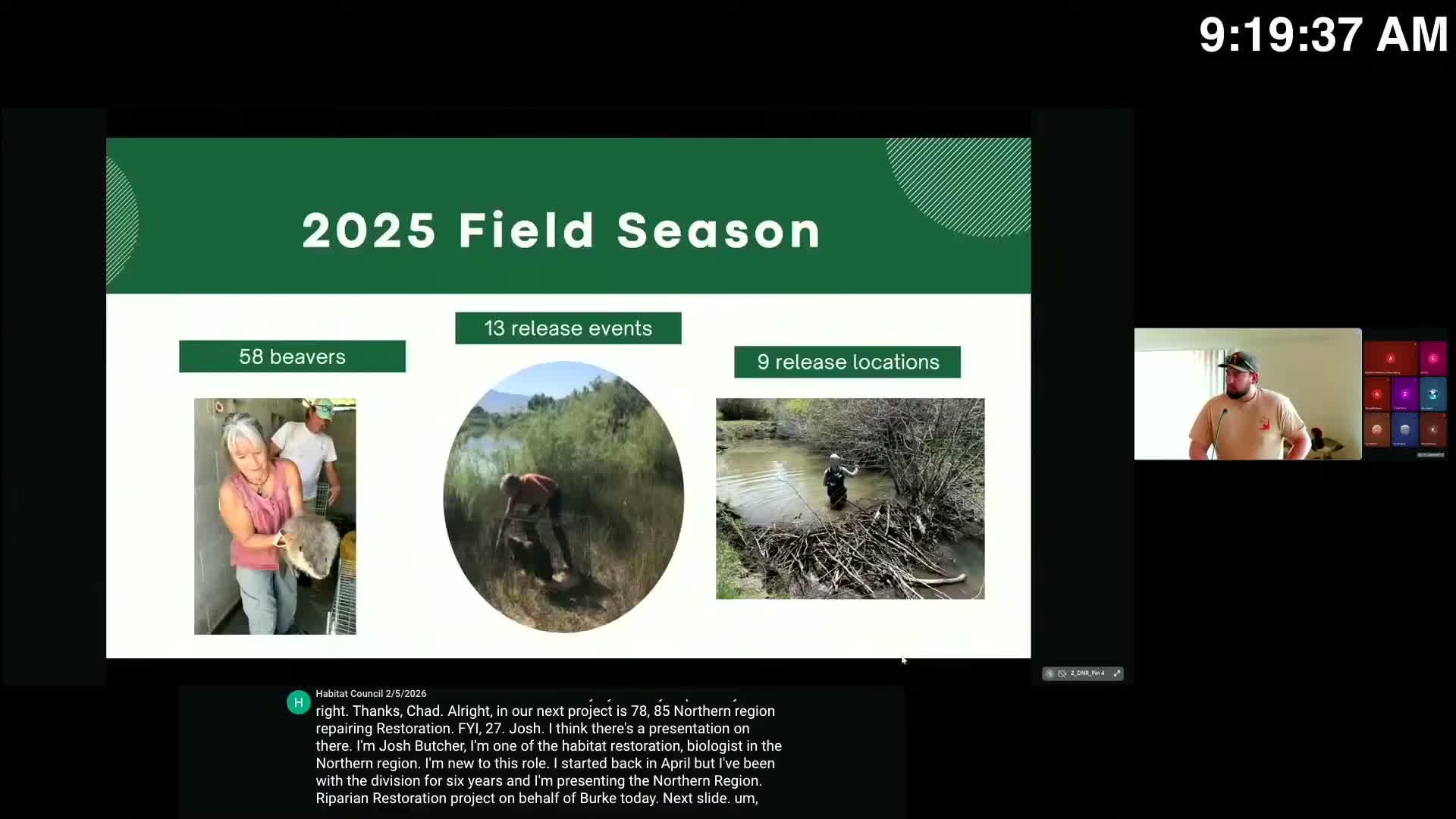
Summary
Council approved expanded beaver and riparian restoration efforts across regions, including relocation, living‑with‑beaver devices, and funding to build a Vernal quarantine facility and run live‑trapper training clinics. Council asked regions to review quarantine cost estimates for consistency.
Robbie Edgel (Central Region habitat restoration biologist) and Gary Besant (Southern Region habitat program manager) summarized regional beaver programs that aim to reintroduce beavers to priority drainages, maintain beaver dam analogs (BDAs), and expand living‑with‑beaver measures.
Edgel described his region’s work: dozens of beavers relocated in recent years, a quarantine site at GBRC (Ephraim), partnerships with USU and Sage Land Collaborative, and use of beaver deceivers (pond‑levelers) and outreach to landowners. Southern Region staff said a focused approach — saturating priority stream reaches for multiple years rather than spreading animals thinly — has produced lasting establishment and measurable aquatic benefits, including deeper pools for fish and improved riparian vegetation.
Tory Mathis presented the Northeast Region’s first‑year beaver relocation proposal: two enclosures proposed at a Vernal Game Farm quarantine facility, living‑with‑beaver installations on private land (culvert protections), a three‑day trapping/relocation clinic, a seasonal technician, purchase of live traps, and a bounty to incentivize live capture. The council approved the program but asked staff to re‑examine the quarantine facility cost estimate and to seek statewide consistency on quarantine designs and expected per‑unit costs.
Council members supported live‑trapping training and bounty incentives to shift local practice away from lethal removals. The council also encouraged coordination across regions so smaller, lower‑cost quarantine designs used elsewhere can inform the Vernal plans. Members asked that beaver pen drain lines and maintenance details be reviewed (to avoid sanitary or clogging problems) and that engineering/materials be optimized for cost and durability.
Next steps: Northeast staff will revise the quarantine cost estimate and coordinate a statewide discussion on quarantine design standards; training clinics and living‑with‑beaver installations will be scheduled for the coming field season.