
Averill Park board flags health insurance, enrollment and staffing as top budget pressures
Get AI-powered insights, summaries, and transcripts
Subscribe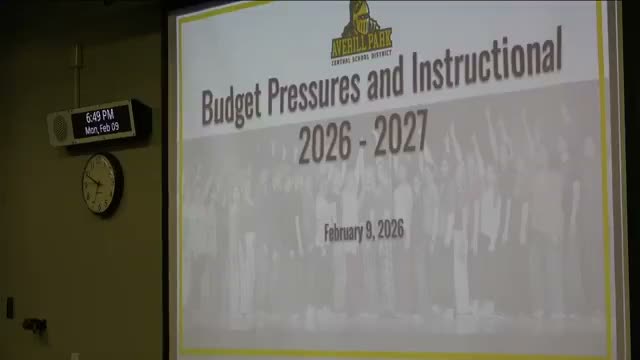
Summary
District staff told the Averill Park Central School District board that health insurance now accounts for roughly 20% of the budget, roughly matching the governor’s proposed foundation aid increase, and outlined possible staffing changes, program impacts and a potential in‑house UPK opportunity if state funding is approved.
Unidentified Speaker 1, a district presenter, told the Averill Park Central School District board that health insurance has become the district’s largest uncontrollable cost and now makes up "approximately 20% of our budget." He and staff presented budget principles — use data, reduce by attrition when possible, and draw on fund balance as needed — and warned that recurring insurance cost increases could outpace modest state aid gains.
The presentation compared the governor’s proposed foundation aid increase (cited by staff at about $1.0 million, roughly a 2.66% increase) with the district’s projected health insurance increase (also about $1.0 million). "Our health insurance increase is nearly twice as much as our total increase in foundation," Unidentified Speaker 1 said, summarizing the arithmetic that leaves the district facing a budget gap unless offsets are found. He also cited family health-plan costs of roughly $42,000 and individual-plan costs of roughly $16,000 per employee.
Instructional leaders described a targeted 'wish list' of positions the district has kept intentionally small because of budget constraints. Unidentified Speaker 4 said the district continues to seek an elementary social worker to cover three schools and additional music staffing for growing middle-school ensembles; he noted the district restored a high-school business teacher last year after reprioritizing requests.
Board members pressed for context on staffing reductions and enrollment trends. Unidentified Speaker 3 asked whether the district’s elimination of 45 positions since 2000 matched enrollment declines; presenters said they have reduced positions through attrition and that enrollment declines have contributed but vary by grade level. At middle school, staff reported a larger projected drop: an outgoing eighth-grade cohort of about 206 students versus an incoming sixth-grade cohort of about 169.
Presenters outlined program impacts that could follow further cuts: larger class sizes, reduced interventions, fewer special-area offerings (music, electives), changes to co-teaching and shifts in special-education configurations. "We have really been reducing through attrition over time," Unidentified Speaker 1 said, and acknowledged those reductions "have an impact" on programs and facilities upkeep.
Staff also highlighted a possible state-funded opportunity: the governor’s proposal would raise per-student UPK (Universal Prekindergarten) funding from under $6,000 toward $10,000. Unidentified Speaker 4 said that if the state rate were approved, the district could consider running UPK in-house without a local budgetary impact, though the proposal is not yet final and timing complicates implementation.
The board did not take final budget votes at the meeting; staff said the next steps include further refinement of staffing proposals and presentation of budget numbers leading to formal budget adoption and referendum items later in the cycle.