Revere meeting on Harris Street pilot draws safety complaints, city promises tweaks and more data
Loading...
Summary
At a public meeting on the Harris Street pilot (day 45 of a 90‑day test), residents described unsafe conditions and spillover traffic onto neighborhood streets; city staff acknowledged data limitations, pledged short‑term fixes (speed humps, snow removal, signal recalibration) and said it will collect more data before a final decision.
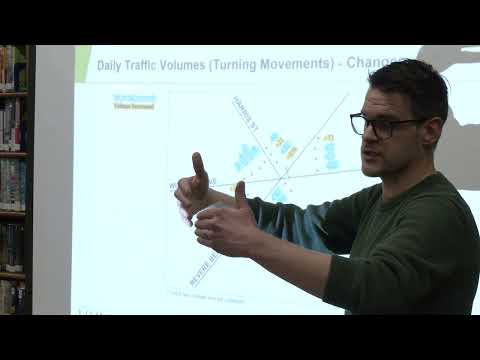
Unidentified Speaker (presenter) told a packed Revere Public Library room that the city’s Harris Street pilot — a conversion intended to change a five‑leg intersection into a four‑leg layout and move regional traffic off a neighborhood street — is at day 45 of a 90‑day test and that staff would present early data and take community feedback.
The presenter said the city’s December and January counts (24‑hour turning‑movement counts and ATR tube counts) suggested roughly 1,000 fewer cars using Harris Street and 1,500 fewer intersection movements after the pilot began, but he cautioned the figures are not definitive: "Are you gonna believe me, or are you gonna believe your lying eyes?" he asked, noting snow, seasonal shifts and limited data points complicate interpretation.
Residents at the meeting said the change has produced dangerous conditions and spillover traffic on narrow neighborhood streets. One resident described a close call and told the meeting it was "totally unsafe, and you're **** lucky someone didn't get killed." Multiple speakers said there is little overhead signage informing drivers about Route 16 East/West and that a lack of public education causes drivers to continue using Harris as a cut‑through, thereby skewing traffic counts.
City staff described steps already taken and short‑term adjustments planned. Staff said they had worked with MassDOT on signal timing and briefly restored an exclusive left‑turn phase after several left‑turn incidents, replaced a pedestrian signal that was struck in a snowstorm and are pursuing faster snow removal at Bell Circle. The presenter said the city will seek access to MassDOT’s continuous signal data, add more local data collection points in March (including on Butler Street), and present findings to the Traffic Commission in April.
Longer term, the presenter said a larger Bell Circle redesign — previously estimated at about $6.7 million in 2019 design documents — remains in MassDOT permitting; the city is pursuing an interim slip lane to ease left‑turn movements but said construction depends on state approvals and negotiation with an affected property owner.
Residents pressed for immediate mitigation: additional signage and a public education campaign, temporary police details at critical locations (particularly near a pediatric office where drivers were reportedly using a parking lot to turn), and removable speed humps on streets experiencing cut‑through traffic. The presenter said the city had already purchased removable speed humps and would deploy them when feasible given weather and operational constraints and would evaluate police details at problem spots.
The meeting highlighted trade‑offs city officials described as inherent to traffic changes: measures that reduce traffic on some streets can increase it on others. Staff said the pilot is meant to test whether converting the five‑leg intersection to a four‑leg configuration improves overall level of service and reduces neighborhood cut‑through traffic, but acknowledged the pilot is not yet producing uniformly positive results and will be tweaked based on community feedback and additional data.
Next steps: the city will (1) expand data collection in March, (2) work with MassDOT on recalibration of signals using updated data, (3) prioritize snow removal on state‑controlled approaches to improve flows, (4) deploy short‑term traffic calming (removable speed humps) where appropriate, and (5) reconvene with the Traffic Commission before making a permanent change. The presenter said staff will share the pilot data package and invite residents to smaller focus groups and that they will publish contact information for continued input.
No formal vote or ordinance was taken at the meeting; residents were told a future Traffic Commission presentation will precede any permanent change to the intersection.
(Reporting based solely on the city meeting transcript.)