Get Full Government Meeting Transcripts, Videos, & Alerts Forever!
Get email alerts on the Public Safety topic
No spam. Unsubscribe anytime.
JSO District 2 highlights crime declines, urges residents to use camera‑sharing and non‑emergency reporting
Summary
A Jacksonville Sheriff's Office District 2 representative reported sector‑level declines in both violent and property crime and urged residents to use the non‑emergency line and a camera‑sharing program to assist investigations. Residents raised concerns about communication during active scenes and limitations on vehicle pursuits.
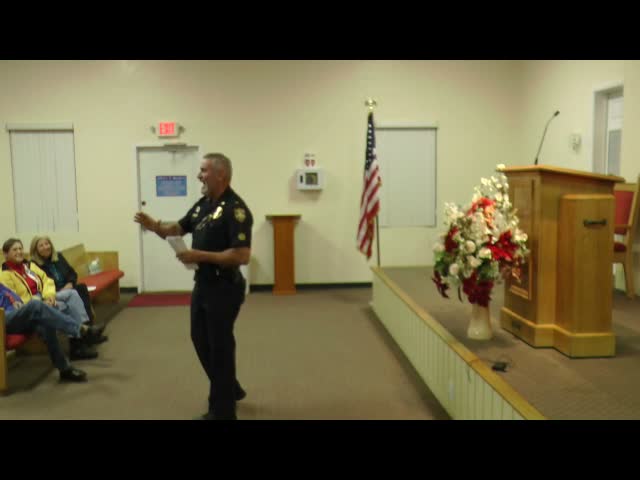
A representative from the Jacksonville Sheriff's Office (District 2) told a District 1 town hall that many local sectors have seen reductions in both violent and property crimes compared with last year. The speaker gave sector breakdowns — several "echo" and "delta" subsectors showed double‑digit percentage declines — and summarized citywide figures as roughly 6% lower in "persons" crimes and 18% lower in property crime, a combined 13% reduction year‑over‑year.
The JSO representative stressed the importance of resident reports and described the department's non‑emergency reporting line for non‑urgent incidents ((904) 630‑0500). He urged residents to call with descriptions (vehicle make/model, direction of travel, license plate) rather than not reporting at all. "Allow us. No matter what, let us come in there," the JSO representative said, noting that calls are triaged by a priority matrix so more serious incidents get immediate response.
The speaker also described a voluntary camera‑sharing program that lets residents register home security cameras so investigators can request footage after a nearby incident. He said the program does not give police ongoing remote access to cameras; instead, officers canvass and ask residents to check or provide footage when it may contain evidence.
Residents questioned the timing of public information after a shooting that closed a bridge and asked why advance warnings were not posted. The JSO representative acknowledged delays in public communications and said the department has been expanding strategic communications capacity to push timely updates. He and other staff emphasized that tactical considerations sometimes limit the detail released during an active scene to avoid endangering officers or compromising investigations.
Town hall attendees also raised enforcement limits related to street racing and takeovers. The JSO representative said policy and safety constraints limit vehicle pursuits when no forcible felony has occurred, and that offenders increasingly use technology and coordination that complicate enforcement. He called for continued community reporting and confirmed JSO's focus on preventing crimes they can realistically deter.
The town hall exchange ended with staff encouraging residents to file 311/online tickets for road/repair issues and to contact their council office for follow‑ups; the JSO representative repeated the request that residents provide as much detail as possible when calling the non‑emergency number so investigators can prioritize appropriately.