Get Full Government Meeting Transcripts, Videos, & Alerts Forever!
Get email alerts on the Municipal Funding topic
No spam. Unsubscribe anytime.
Laramie officials brief legislators on options to stabilize local government funding
Summary
City staff told state lawmakers that proposals to shift more sales-and-use tax back to local governments could make revenue more stable but may leave a statewide shortfall; staff urged careful analysis of distribution formulas and noted Laramie’s budgeting practice of treating one-time receipts as capital funding.
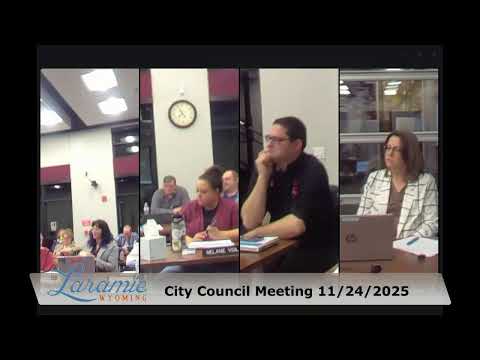
Laramie — City staff and local legislators met Nov. 24 to discuss several proposals before the 2026 legislature aimed at stabilizing municipal revenue, including a plan to divert a fixed share of state sales-and-use tax back to cities and counties.
Assistant City Manager Todd Feizer and Administrative Services staff framed the discussion around three priorities: housing, local control and sustainable municipal funding. Director Wade summarized current proposals under consideration in the Legislature, saying one committee draft would return 5.6% of state sales-and-use tax collections to local governments while associations had proposed 8%. "WAM and WCCA proposed initially 8% or a 146,000,000," a staff presenter said; another presenter described the 5.6% draft as roughly a $105,000,000 distribution. Staff and lawmakers noted that, depending on which approach passes, there could be about a $20 million gap compared with previous distributions.
Why it matters: Laramie officials said local option taxes and one-time receipts have been crucial to city capital spending, and any fundamental change in state revenue sharing would reshape local capital plans and voter expectations. "We have been managing the direct distribution as one-time revenue for quite a long time," a city presenter said, adding that the city builds ongoing services from ongoing revenues and treats one-time receipts as capital funding.
What officials said: City staff emphasized that shifting to a sales-and-use tax distribution would change the character of local funding — it could offer more predictability but would also mean communities "share up and share down," with winners and losers depending on the final formula. Staff repeatedly referenced the Madden formula — the statutory mechanism that determines how distribution is calculated — and warned that changes might reduce hardship aid for communities that have low per-capita sales tax receipts.
Legislators’ concerns: Several lawmakers pressed city staff to supply concise, data-driven one-pagers showing local impacts of competing proposals. Some legislators raised equity concerns, saying replacing property tax with a larger sales-tax base could impose a regressive burden on low-income households in places with higher renter populations.
What comes next: City staff asked legislators to stay in close contact during the session and offered to provide timely analyses and contacts so lawmakers can evaluate specific bills and potential budget amendments. No formal action or vote was taken at the meeting.