
Texas Supreme Court Hears Argument Over Scope of Home‑Equity Forfeiture Remedy
Get AI-powered insights, summaries, and transcripts
Subscribe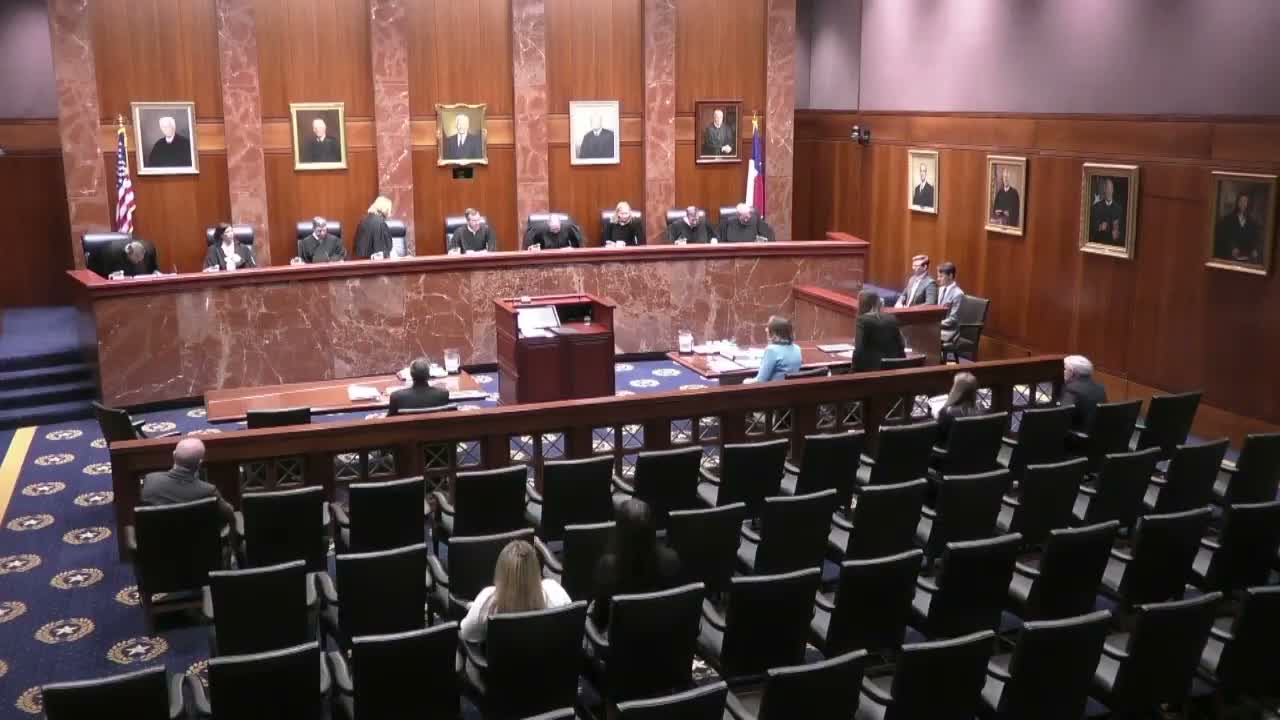
Summary
At oral argument in Stahb v. Beebe, BBVA, lawyers and justices debated whether the forfeiture remedy in Texas Constitution §50(a) applies to minor post‑origination breaches (like paperless‑statement errors) or only to failures tied to 25 constitutionally enumerated terms and curable harms.
The Supreme Court of Texas heard oral argument Wednesday in Stahb v. Beebe, BBVA over whether the forfeiture remedy in Texas Constitution §50(a) can be used for minor post‑origination breaches of home‑equity loan contracts.
Speaker 1 (Justice, unnamed) opened by identifying the case and pressing counsel on a hypothetical in which a borrower who opted for paperless statements nonetheless received paper mailings. "You're telling me there's forfeiture in that scenario if that's part of the agreement?" the Justice asked, pressing whether the forfeiture remedy was intended for such minor infractions.
Speaker 2 (Counsel, unnamed) urged the Court to read §50(a) in light of its purpose: to permit home equity lending in Texas while guarding against forced sale of homesteads. "The Texas constitution is not concerned with paperless statements," Speaker 2 argued, saying the provision targets violations of the constitutionally enumerated 25 terms and conditions of an extension of credit and requires a curative measure that actually fixes the harm.
Counsel and justices debated the text of the curative measures in §50(a)(6)(f), including the constitutionally prescribed options such as a refund of credit (commonly $1,000 in the provision) or an offer to refinance. Speaker 1 pressed whether an offer alone — even if it were not accepted — should avoid forfeiture, noting the constitution "doesn't say there has to be an agreement. It says there has to be an offer." Speaker 2 countered that the Court's precedent in Garofalo requires the offered cure to actually remedy the problem rather than be merely hollow.
A central factual dispute discussed at argument was scale: counsel said the billing error at issue could be as large as $10,000, while the constitution's $1,000 refund might not make a borrower whole for that error. "If the billing error here was $10,000," Speaker 2 said, "the thousand dollars doesn't make the plaintiff whole." The justices repeatedly framed the question as a textual one — whether the cure language ties forfeiture to constitutionally mandated terms — and as a practical one about market consequences.
Amicus briefs from banking groups were invoked repeatedly. Counsel warned that adopting the plaintiffs' expansive reading could change the risk profile for Texas lenders, restricting or eliminating access to home‑equity lines of credit (HELOCs) in the state. "We're not gonna offer HELOCs because the risk will be too great," one line of argument from the briefs summarized during argument.
No decision was announced. At the close of argument, Speaker 1 announced the case was submitted and the Court adjourned. The Court's eventual opinion will resolve whether forfeiture is limited to breaches of the constitutionally enumerated terms that can be cured in a way that actually remedies the harm, or whether the remedy can be applied more broadly to other lender obligations or minor infractions.
Next steps: the Court will issue a written opinion deciding the legal questions argued; no timeline for decision was stated from the bench.