
Texas Supreme Court hears challenge over when malpractice clock starts in gender‑affirming‑care case
Get AI-powered insights, summaries, and transcripts
Sign Up Free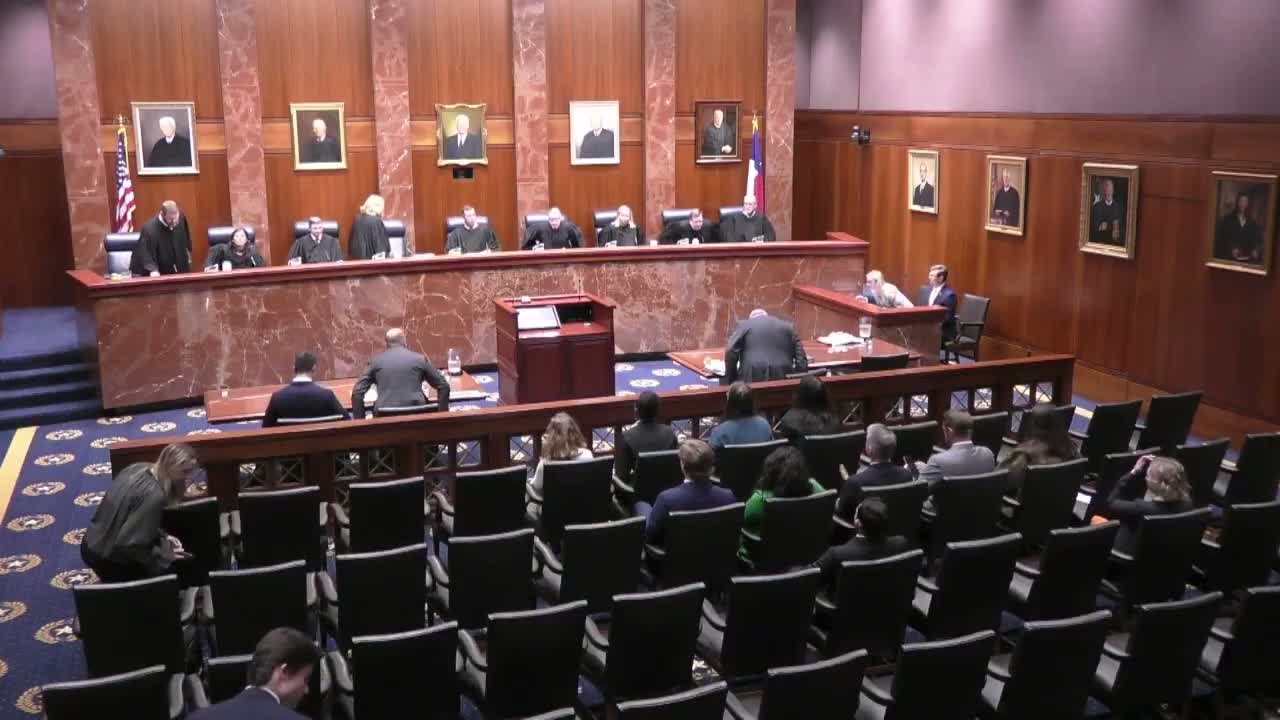
Summary
In Altocco v. Wood, petitioner’s counsel told the Supreme Court of Texas that the two‑year limitations period for health‑care‑liability claims should not run until an injury exists, arguing a referral letter that preceded surgery did not start the clock; several justices questioned whether that reading would force plaintiffs to sue before they had standing.
The Supreme Court of Texas heard argument in Altocco v. Wood on whether the two‑year limitations period for health‑care‑liability claims begins when a referring letter is written, when treatment is completed, or when an allegedly harmful surgery occurs.
Mister Raymer, arguing for petitioner, told the court the limitations period "does not begin to run before the claimant is even insured," and urged the justices to read the statute to require an injury before the clock starts. Raymer emphasized the facts of the case involved gender‑affirming care in which a therapist’s required certification letter preceded the later surgery. "The letter was the gateway to the injury," Raymer said, arguing that the letter created the causal link that later allowed a suit to be brought.
Raymer framed the statutory question around Section 74.251 (as discussed in argument), saying the statute’s reference to "tort" and the statutory definition of a health‑care‑liability claim incorporate an injury requirement. He told the court that when a claim "sounds in tort" the two‑year limit should run from the date the plaintiff has a cause of action (i.e., when injury has occurred), not from the earlier act of drafting a recommendation or referral.
Several justices pushed back with hypotheticals and precedent. One justice asked whether, under petitioner’s reading, a plaintiff who delays surgery for years and then sues immediately after would be "time barred before they ever had a claim?" The justice said such a result could raise constitutional concerns about requiring a plaintiff to sue before having standing. Another justice noted the court’s earlier decision in Shaw (2001), which the bench has read to require limitations to begin on an "ascertainable" date of the alleged tort, and asked how that precedent fits with the petitioner’s textual reading.
The bench also questioned practical consequences. A justice warned that adopting a rule tied to inducement or ongoing advice might blur the line between ordinary advice and actionable torts, and could "open the floodgates" to claims similar to failure‑to‑diagnose or other long‑running treatment scenarios. Raymer answered that the statute’s separate repose and the open‑courts provision would prevent unfair results in extreme delay cases and that existing case law can constrain abuse.
A procedural detail discussed during argument concerned notice under Section 74.051; the record was said to include a notice sent on 05/09/2023, and counsel offered to provide a precise clerk‑record citation. The argument concluded after petitioner’s rebuttal time, and the court submitted the case for decision.
Outcome and next steps: The court took the case under advisement at the close of argument; no decision was announced from the bench. The justices’ questions focused on statutory text, prior precedent (including Shaw), and the practical and constitutional implications of reading accrual to occur before an injury.
Altocco v. Wood was argued before the Supreme Court of Texas and submitted for decision.