
Texas high court hears challenge to 'primary jurisdiction' referrals to federal STB in railroad case
Get AI-powered insights, summaries, and transcripts
Subscribe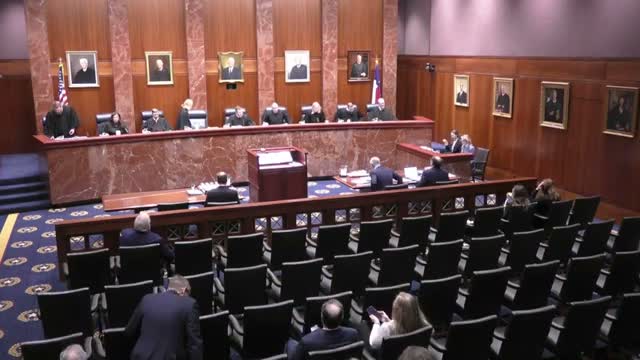
Summary
At oral argument in case No. 250149, counsel for the relator urged the Texas Supreme Court to rein in or overrule the primary jurisdiction doctrine that permits state courts to refer legal questions to federal agencies like the Surface Transportation Board; opposing counsel said the STB remains a useful tool where it has concurrent authority.
The Supreme Court of Texas on Wednesday heard argument in case No. 250149 over whether state courts may, as a matter of doctrine, refer legal questions about railroad common-carrier status to federal agencies such as the Surface Transportation Board (STB).
Counsel for the relator (Speaker 1) told the court that Texas law requires courts to decide questions of law de novo and should not routinely outsource adjudication to executive agencies. "State courts must decide questions of law, including questions of statutory interpretation, de novo, without giving deference to any legal determination by a state agency," Speaker 1 said during argument, urging the court to limit or overrule the primary jurisdiction doctrine that permits referrals.
The relator argued the question in this case is "inherently judicial" and pointed to older Texas precedent that, in counsel's view, bars referral where an agency lacks authority to make essential findings affecting relief. Counsel emphasized that where an agency cannot grant the relief sought or make findings essential to that relief, primary jurisdiction should not apply.
Opposing counsel for the real party in interest (Speaker 2) acknowledged the doctrinal dispute but said the STB and its statutory authority (cited in argument as sources such as 49 U.S.C. provisions and the ICCTA framework) provide expertise that courts may properly consult. "If the court determines that it needs the expertise of the Surface Transportation Board, it should have it in its pocket," Speaker 2 said, describing the STB as a tool trial courts can use when operations and industry changes make agency input useful.
A central practical dispute at argument was the STB's statutory scope. Relator's counsel argued that certain federal provisions limit the STB to determining its own jurisdiction and that, because the STB cannot take official action on workplace safety or on the relief requested here, sending the case there would produce a nonbinding advisory result. "All the STB could do here would be to determine it has jurisdiction and then to conclude without taking any official action," Speaker 1 said, arguing that such a referral would not advance adjudication.
Justices asked detailed questions about precedent (including references to LoperBright and Chevron-era doctrines), whether FELA's concurrent-jurisdiction structure mattered here, and how STB procedure and timing (briefing schedules, stays, and possible reconsideration) operate in practice. Both counsel emphasized that common-carrier status is fact-bound and that trial courts retain discretion; they disputed whether that discretion extends to mandatory referrals.
No decision was announced from the bench. After the bench completed questioning, the court recessed and the case was submitted for decision.