Get Full Government Meeting Transcripts, Videos, & Alerts Forever!
Get email alerts on the Tuition Bill topic
No spam. Unsubscribe anytime.
FCPS tuition bill rises; Fairfax City’s share up about $7.6 million in FY25, board told
Summary
Fairfax City School Board heard a tuition‑bill presentation detailing a systemwide FY25 operational increase of about $259.1 million and a roughly $7.6 million increase for Fairfax City. Presenters said enrollment share shifts and reduced pandemic-era revenue credits were major drivers.
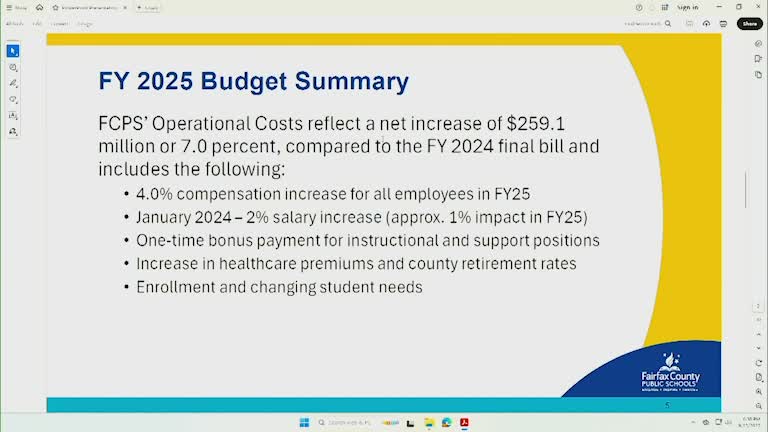
FCPS budget staff told the Fairfax City School Board on Sept. 15 that the division’s operational spending rose about $259.1 million (roughly 7%) in FY25 and that Fairfax City’s FY25 tuition bill rose about $7.6 million versus FY24.
Matthew Norton, assistant director for budget services, said salary and benefit increases, a one‑time bonus, higher health‑care and retirement costs, and changing student needs were the largest drivers of the systemwide increase. Norton said roughly 60% of Fairfax City’s $7.6 million increase (about $4.6 million) reflects routine budgetary changes such as compensation and inflation. He described an additional ~$1.4 million tied to small shifts in the city’s share of average daily membership (ADM) and smaller amounts attributed to lower revenue credits and city‑funded positions.
Why a small enrollment shift matters: Norton illustrated how sensitive the formula is to enrollment share. He said a 0.01 percentage‑point change in the city’s share of students is roughly equivalent to $355,000 on the bill; Fairfax City’s share moved from about 1.66% to 1.71% in the recent calculation, which amplified the bill change.
Norton also described ‘revenue credits’—state and federal funding that reduce the city’s bill—and said those credits have declined toward pre‑pandemic levels. He estimated that reduced revenue credits contributed about $1.5 million to the city’s FY25 increase. That change reflects the winding down of one‑time pandemic and targeted state funding, and in some cases the county has continued programs with other funding sources while others have been sunset.
On the bottom line, Norton reported the division’s final FY25 bill was $66.2 million systemwide while Fairfax City had budgeted $63.6 million, producing roughly a $2.6 million variance between the city’s original budget and the final bill. He and board members clarified that the final bill calculation treats classroom rental as a discount (excluded from the final bill) while the city’s budget presentation adds rental back in to compare to its own top‑line figure.
Looking ahead, Norton said FY26 pressures are likely to continue from enrollment share changes and salary inflation; the city’s proposed FY26 budget includes a larger tuition line ($69 million) that may absorb some but not all risks. Norton urged the board to expect continued attention on enrollment trends, special education costs and the broader county‑level boundary study that can influence future shares.
The presentation prompted several board questions about specific multiyear investments, program classifications and how ‘other operational’ costs (for example special education, transportation and central services) are grouped for billing. Norton clarified that some items cited as multiyear investments include an HR/human capital management system, inclusive preschool expansion (countywide, cited as roughly $2 million in the county budget), athletic expansions and certified athletic trainers. Board members requested follow‑up materials breaking out the components of the city’s operating charge and the timing of the ADM counts used in calculations.
The board did not take formal action on the tuition bill at the meeting; staff said final calculations are produced after the fiscal year closes and that more detail would be available in subsequent budget work sessions.