
COG briefs Fairfax council on DMV Moves regional transit plan; city financial exposure expected to be modest but recurring
Get AI-powered insights, summaries, and transcripts
Sign Up Free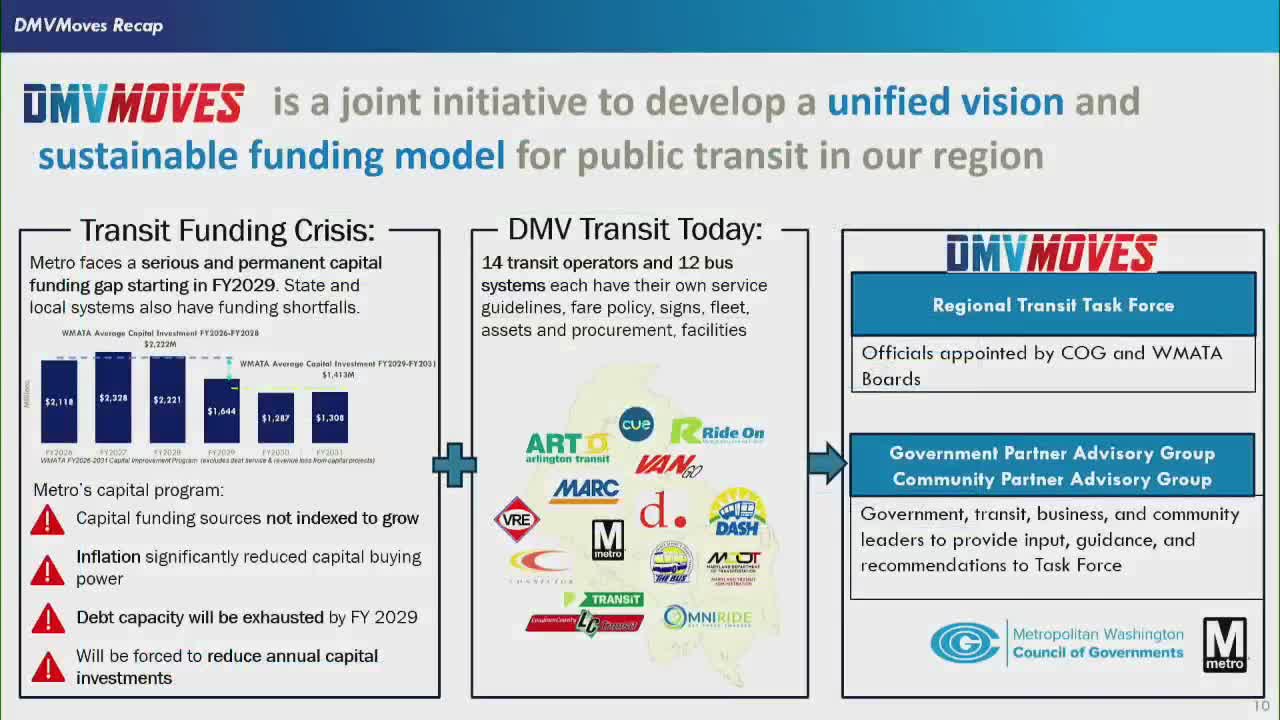
Summary
A Metropolitan Washington Council of Governments deputy director briefed council on the DMV Moves plan, noting a $460M/yr WMATA funding need (regional) and recommending corridor-level BRT and operator coordination. Staff estimated a potential additional ongoing city contribution in the low six figures to several hundred thousand dollars depending on options.
A deputy director from the Metropolitan Washington Council of Governments (COG) briefed Fairfax City Council on Feb. 10 about the DMV Moves regional mobility plan, its priorities and implications for local jurisdictions.
The presenter explained COG’s role as the region’s Metropolitan Planning Organization and the Transportation Planning Board, noting that federal transportation funds are delivered through MPO long‑range plans. He summarized the DMV Moves task force findings: WMATA requires sustained capital funding (COG cited an estimate of roughly $460 million per year across the region to bring systems up to a modern standard), the region should pilot a small set of Bus Rapid Transit corridors, local transit operators (14 different bus systems) need both capital and operating support, and better operator coordination could improve transfers and rider experience without necessarily requiring all new capital.
When councilmembers asked about likely local costs, the presenter used the example allocation method for the WMATA need and suggested Virginia’s share might be about $136 million per year of the regional need; staff-level modeling indicated the City of Fairfax’s additional local share could be on the order of $620,000 per year for WMATA funding responsibilities plus perhaps $220,000 per year in additional operating funds to enhance local bus services if the city pursued a comprehensive package — a combined illustrative figure of roughly $840,000 annually if all elements were implemented simultaneously. The presenter cautioned these are modeling estimates: formula updates, project selection, and choices about timing and policy contributions would alter the final number.
Council members sought clarifications about BRT corridors, local implementation flexibility, and forecast updates. The COG presenter said DMV Moves is descriptive—offering tiers and options—rather than prescriptive; detailed corridor, design and lane decisions would defer to local governments and implementing agencies. He noted COG and the Transportation Planning Board can coordinate operator discussions and pursue cooperative procurement and grant opportunities that could reduce per-jurisdiction cost burdens.
Council thanked the presenter and noted a consent-item resolution would be coming later to endorse the plan. Several councilmembers emphasized the need to understand precise city fiscal exposure and phasing before committing to legislation or recurring contributions.
The briefing underscored regional interdependence: staff and council framed the plan as a regional blueprint that the city may choose to endorse, advocate for in Richmond, or implement selectively according to local policy and fiscal priorities.