Get Full Government Meeting Transcripts, Videos, & Alerts Forever!
Get email alerts on the Urban Forest Master Plan topic
No spam. Unsubscribe anytime.
Fairfax Planning Commission recommends Urban Forest Master Plan to City Council
Summary
The Planning Commission recommended the city’s first Urban Forest Master Plan to City Council before the council’s adoption hearing. The 20-year plan sets canopy, preservation and staffing goals, and includes targets such as a 5% canopy increase in low-canopy areas by 2035.
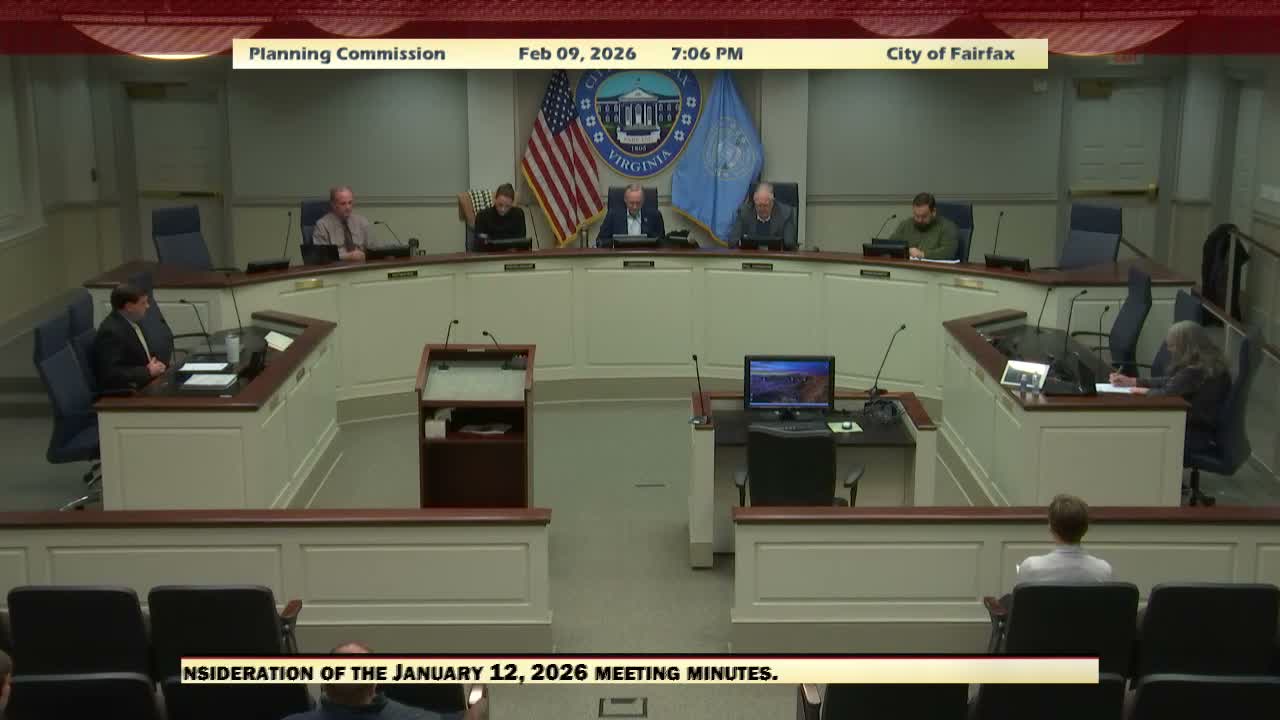
On Feb. 9, 2026, the Fairfax City Planning Commission voted unanimously to recommend the Urban Forest Master Plan to City Council, which will consider adoption at its Feb. 10 meeting.
The plan, presented by Urban Forest Manager Anna Stafford, lays out a 20-year roadmap for protecting, growing and managing Fairfax City’s public tree canopy. Stafford told the commission the project began 18 months ago and built on recommendations from a 2021 Urban Forestry Program Evaluation and a subsequent Sprout Initiative funded in part by a U.S. Forest Service grant. “The goal is to create a 20 year roadmap for the stewardship of Fairfax’s urban forest through protection, regulation, growth and management,” Stafford said.
Staff highlighted key findings and measurable goals in the plan. A citywide canopy analysis and a 2023 public-tree inventory found tree canopy covers about 40% of the city’s land area. Staff estimated the urban forest provides roughly $1,200,000 in annual benefits, alongside non‑monetary contributions to health, community character and property values. The draft contains five objectives, 21 strategies and 171 actions, and identifies 13 key performance indicators, including a target to increase canopy cover by 5% in low-canopy areas by 2035 and to achieve a greater than 90% survival rate for newly planted trees.
Commissioners and staff focused on implementation questions — staffing, budgeting and regional coordination. Stafford said roughly 40 of the plan’s actions are already underway and that the plan will produce implementation deliverables such as an annual work plan, guidance for natural‑areas assessments and workflows to integrate urban forestry tasks into daily operations. The presentation also added a recommended action to Strategy 1.2 to partner with regional forecasting and modeling initiatives, noting that much climate and canopy forecasting work is typically done at county or regional scales.
Commissioner discussion was brief. A motion to recommend the December 2025 draft to City Council was made and seconded; the commission voted unanimously in favor. The plan will now be heard at City Council on Feb. 10.
What happens next: If City Council adopts the plan, staff said the city will use the plan to guide amendments to the comprehensive plan and to develop implementing policies and budgets. The adoption will also trigger further work on a tree preservation ordinance and related implementation items noted in the plan.