Eye‑tracking study finds visual context shapes how latent‑print examiners search and decide

Research presentation (conference session) · February 13, 2026

Get AI-powered insights, summaries, and transcripts

Subscribe
AI-Generated Content: All content on this page was generated by AI to highlight key points from the meeting. For complete details and context, we recommend watching the full video. so we can fix them.

Summary

A research team led by Austin Hicklin presented eye‑tracking evidence that visual context (latent vs. exemplar vs. cropped views) changes where examiners look, how long they search and how quickly they reach a decision; the study used about 121 practicing examiners and produced two forthcoming papers.

Austin Hicklin, senior fellow at Noblis, presented results from an eye‑tracking study of latent‑print examiners, saying the data reveal how examiners search fingerprint images and why they sometimes reach different conclusions. "So we're talking about eye tracking for latent print examinations," Hicklin told attendees, framing the work as a complement to previous accuracy studies.

Hicklin said the project—co‑authored by Joanne Buscaglia (research chemist, FBI Laboratory), Brad Olery (Noblis), Tony Roberts (FBI Laboratory) and Tom Busey (Indiana University)—used head‑stabilized eye tracking sampling about 1,000 times per second and a registration process that maps gaze to image points with an accuracy on the order of a ridge. "It provides us more detailed and more complete information on how examiners conduct their comparisons," he said.

The experiment included roughly 121 practicing latent‑print examiners who each spent about two hours on tasks. Hicklin described two stages: a localization stage (directed "find the target" tasks) and full comparison trials. For redundancy, about 30 examiners viewed each image pair so the team could compare different examiners' behaviors on identical images.

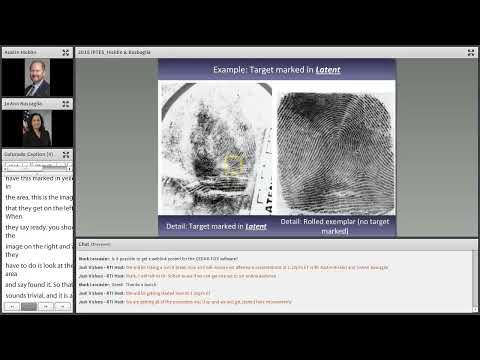
Hicklin demonstrated three image contexts used in the tests: a latent image with surrounding visual context, a rolled exemplar (plain) and a cropped target with no visual context. Aggregated fixation maps showed most examiners focused inside marked target boxes when full context was present, while cropped images produced more dispersed fixations. Hicklin summarized the effect: without visual context, "examiners generally view much larger portions of the image" and spend more time searching.

Timing differences were marked, he said: cropped images took roughly twice as long as latent images and about three times as long as plain exemplar comparisons. Hicklin described two behavioral phases that emerged in the data—an early rapid "scanning" phase where examiners hunt across the image, and a later slow, repetitive phase (about 4–12 seconds) of detailed inspection where examiners revisit the same locations while deciding if a match is present.

Hicklin emphasized the operational importance of the findings. "Errors are a major problem," he said, noting that disagreements sometimes indicate examiners are not taking full advantage of the evidence or that they differ in how they use visual context. He said the team is preparing a first paper and working on follow‑up analysis that applies localization metrics to full comparisons to explain false positives, false negatives and non‑consensus determinations.

The presentation outlined methods, sample sizes and early behavioral results; the authors plan two publications, with the follow‑up analysis aimed at clarifying why examiners diverge on identifications and whether measured behaviors can predict errors. The talk concluded with an offer of more information from the author team and no formal policy recommendations or votes were taken at the session.