
Research presentation: study finds about 50 words brings random match probability near 1%; NIJ project planned
Get AI-powered insights, summaries, and transcripts
Subscribe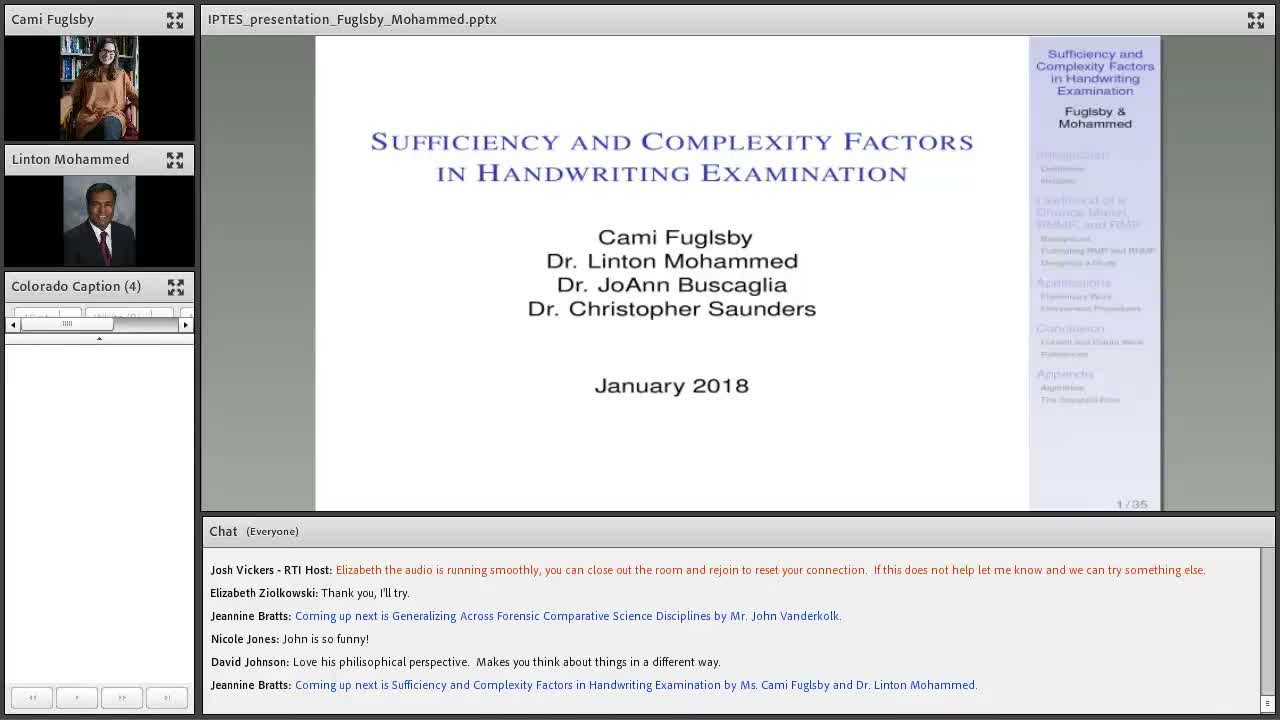
Summary
Presenters reported that in automated and examiner comparisons, random match probability falls to roughly 1% at about 50 words and announced an upcoming NIJ-funded project to test kinematic features and expand FlashID validation using Alabama and FBI convenience samples.
An expert presenting on handwriting-examination methods said that both automated metrics and examiner judgments show random match probabilities fall sharply as exemplar length increases, reaching roughly a 1% random match probability at about 50 words. The presenter emphasized that examiners should collect as many exemplars as possible: "my answer is always as much as you can give me."
The presenters described their estimation approach using a similarity-score threshold (tau) to classify pairs of documents as matches or non-matches and treating the resulting estimator as a U-statistic. They used a convenience dataset referred to as the "FBI 100" (100 volunteer writers each providing five modified London-letter specimens) processed by Syometrics/FlashID as part of a biometric-verification task. The team reported results across word counts from 10 to 100 and showed that, with tau set near a 1% quantile, estimated random match probability approaches about 1% near the 50-word mark (presenter phrasing: "reaching about 1% random match probability").
Presenters also discussed differences between handwritten text and signatures, clarified terminology (e.g., 'allograph' and 'character'), and noted that handwriting is best modeled as a distribution of natural variation rather than a static identifier like DNA or fingerprints. They flagged limitations in short-word cases—such as using the word "Alabama"—that may require specialized algorithms because of limited character counts.
The session included acknowledgements of collaborators and agencies (including the FBI and NIJ) and a statement that parts of the work were supported by grants and contracts; presenters explicitly noted that the views expressed are the authors' and do not necessarily represent official positions of the National Institute of Justice or the FBI. The lead presenter said the research will inform an upcoming NIJ-funded kinematic study and near-term FlashID validation work.
The presenters closed by pointing listeners to references and an online appendix and invited questions.