Get Full Government Meeting Transcripts, Videos, & Alerts Forever!
Get email alerts on the Student Advisory Committee topic
No spam. Unsubscribe anytime.
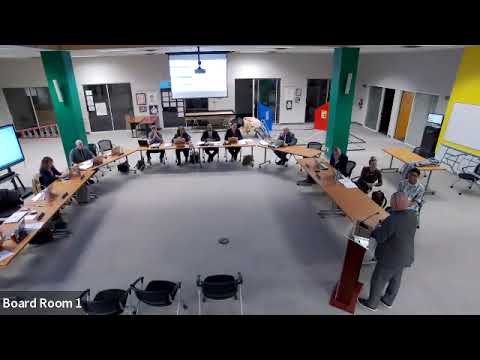
Student advisory committee presents rubric to Sycamore board; recommends 'healthy start times' move forward
Summary
A Student Advisory Committee (SAC) presented a standardized rubric to evaluate past and future SAC projects and used 'healthy start times' as an example; the panel scored that project high (23/24) and recommended it move forward, while board members asked for clear ownership, timely decisions and published review matrices.
Gabby Janssen Bostecker, speaking for the Student Advisory Committee, presented a new rubric the group developed to review past and future SAC projects and to make implementation recommendations to the Sycamore Community Schools Board of Education. The rubric scores projects across eight categories (alignment to district mission and portrait of an aviator, student impact, equity and inclusion, feasibility, measurable outcomes, community engagement and sustainability) using a 3–2–1–0 scale, with a total possible score of 24.
"We designed a process that's gonna be clear and repeatable, for reviewing past and future SAC projects," Janssen Bostecker said, outlining how projects would be inventoried, scored and categorized as 'move forward,' 'rescope,' or 'archive.' She and other student presenters said the rubric is intended to keep recommendations mission driven, not political.
As an illustration, the committee walked the board through a scoring exercise for a 'Healthy start times' project that yielded a cumulative score the presenters described as 23, which they said places the initiative in the 'move forward' category. The presenters recommended publishing the review matrix and monitoring outcomes year to year so the board and community can see how projects align to the district strategic plan.
Board members probed how the evaluation team would be structured and who would carry out implementation. One board member asked whether the evaluators should be district administrators, SAC members, or a mixed panel; presenters and trustees said district representation will be needed and recommended an uneven-numbered panel to manage votes. Presenters suggested doing the inventory immediately at the end of each school year so decisions are timely.
Multiple trustees praised the rubric as a way to make subjective topics more objective. "It was an educational rubric and an educational framework to look at this, and it made it incredibly easy to work within the district," a presenter said. Board members requested the administration provide the administrative guidelines and a published tab in the proposed spreadsheet so projects and future proposals are visible and easy to assign for the following year.
The SAC suggested embedding project reviews into existing district systems — board retreats, planning processes and periodic check-ins — so that implementation has clear ownership and follow-up. Board members agreed to form a small team to work with SAC representatives on next steps, including how projects are assigned to administrators or archived.
The presentation concluded with the board thanking the students and asking administration to return with any needed administrative guidelines or clarifications; the board set follow-up work sessions to continue implementation planning.