Get Full Government Meeting Transcripts, Videos, & Alerts Forever!
Get email alerts on the Street Funding topic
No spam. Unsubscribe anytime.
Heath council debates how to sustain aggressive street-repair pace; staff to run funding scenarios
Summary
Councilmembers debated whether to reallocate capital, use fund balances, or pursue debt to sustain an aggressive street-repair pace and avoid leaving vulnerable bridges and streets unaddressed; staff will run detailed funding scenarios and return to council.
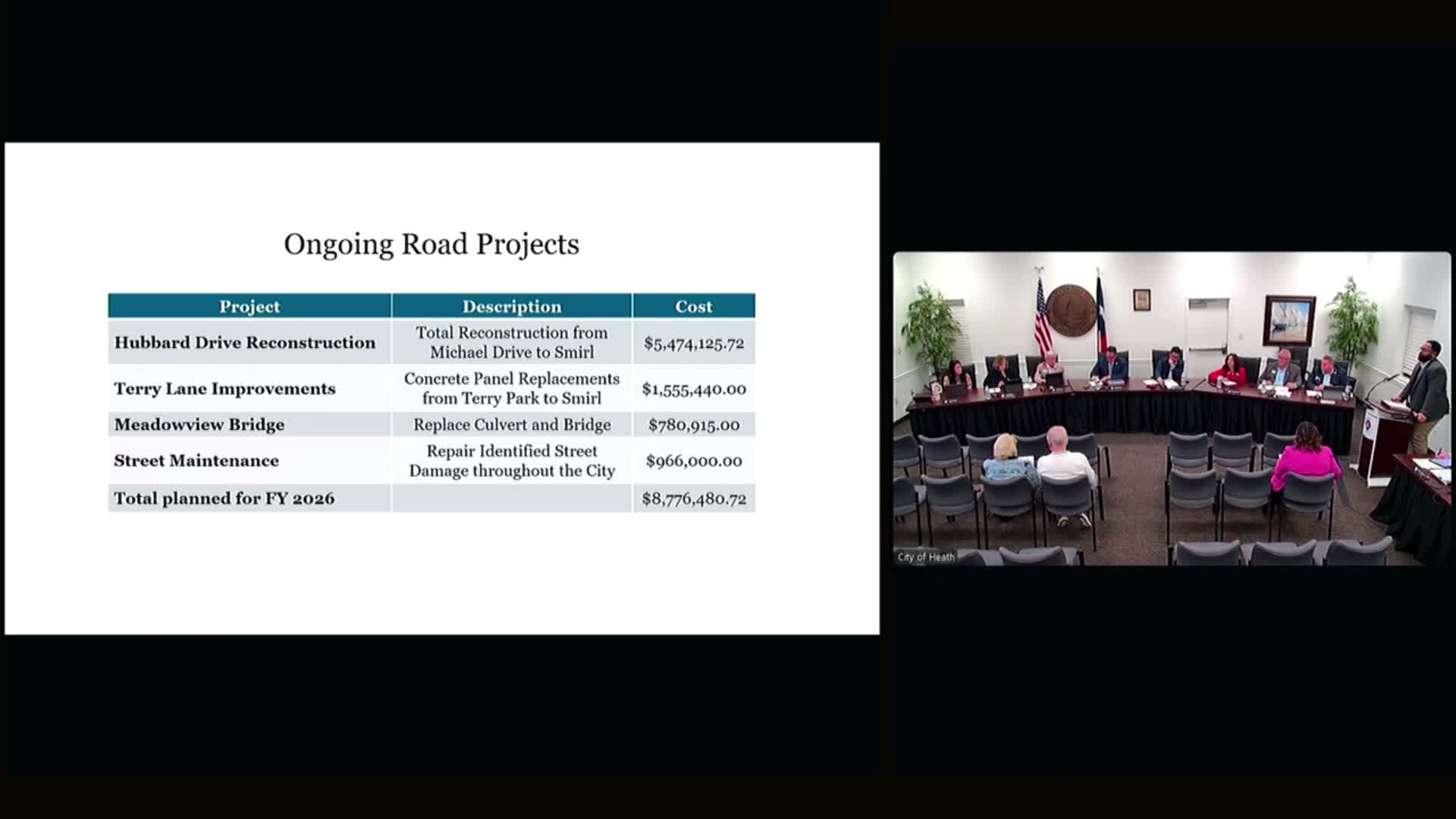
Councilmembers at the Feb. 10 meeting discussed how to keep a high tempo of street repairs without exhausting fund balances needed for potential catastrophic failures. Staff presented a recap of current and upcoming road work that includes a $5.4 million Hover Drive reconstruction, $1.5 million Terry Lane improvements reimbursed by Kaufman County, and a street-maintenance program of roughly $966,000; the full FY26 road plan was presented at about $8.7 million.
Council members emphasized the trade-off between spending to repair many streets quickly and retaining reserves for major, unexpected reconstruction needs such as bridges. Several members noted that at current spending rates the city's remaining street-maintenance balance could be quickly depleted and estimated an additional near-term funding need in the low hundreds of thousands to maintain the current pace. One council member summarized the near-term arithmetic by saying the city needed "another $250,000" to continue repairs at the current rate while staff runs a fuller analysis.
Staff identified four broad funding options to be examined: reallocation of existing capital funds, use of available fund balance, pay-as-you-go funding, and debt issuance. The staff said it had not yet run a comprehensive number showing what it would cost to address all identified street issues at the current repair cadence and agreed to return with a detailed financial exercise showing options and trade-offs.
No formal action was taken; council direction was to keep the discussion active, preserve fund balances for potential catastrophic failures (bridges), and identify practical midyear reallocations if feasible.