Get Full Government Meeting Transcripts, Videos, & Alerts Forever!
Get email alerts on the Sewer Laterals topic
No spam. Unsubscribe anytime.
City staff to propose inspection-upon-sale ordinance and offset reforms for failing sewer laterals
Summary
City staff told developers they will ask the City Council to consider an ordinance in April that would require inspection upon sale and mandatory replacement of laterals in constrained areas within 12 months, expand rebate eligibility and refine offset credit calculations.
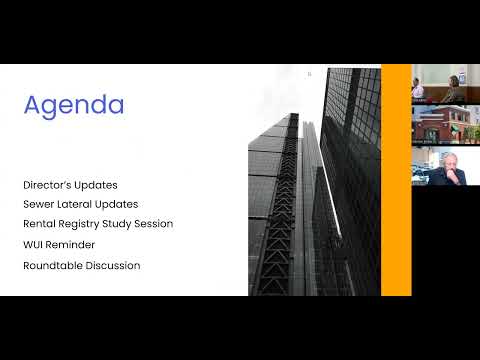
City staff presented detailed updates on the municipal sewer-lateral program and previewed an ordinance they plan to bring to the City Council in April that would require inspection upon sale and mandate replacement of private sewer laterals in poor or failed condition in capacity-constrained areas.
Chris, a city staff presenter, said the proposal is intended to address the contribution of failing private laterals to overall wastewater flow and capacity constraints. "We will be proposing, and this could change before April, but, we're talking about those properties, again, focusing on capacity constrained areas as a start," Chris said, adding that properties with laterals identified as "poor or failed condition would be required to be replaced" and would have "12 months" to complete the work and remain eligible for rebate programs.
Staff also described changes the council adopted on Dec. 2, which the city has already published: an updated capacity-constraint map (two areas added) and two rebate programs. Chris said a new $350 rebate for CCTV camera inspections of private laterals is live and that the existing $4,000 replacement rebate has been adjusted to expand eligibility for multifamily and commercial properties located in the constrained areas, while single-family remains citywide.
Developers raised multiple implementation and equity questions. One attendee summarized the potential scale by citing study averages: "One poor condition lateral contributes 26 times the sewer flow of a good condition lateral," noting that replacing a relatively small number of failing laterals could materially change capacity calculations. Staff cited prior engineering analyses (ElectroScan work and a West Yost flow study) and said they will bring framing and sensitivity analyses to council materials but do not yet have a finalized equivalency factor.
Discussion focused on several technical and policy points staff plans to refine before formal council consideration: whether mandatory replacement should be limited to sale-triggered inspections or apply whenever a failed lateral is identified; how to translate lateral-condition improvements into EDU (equivalent dwelling unit) credits for offsets; and whether the fixture-count threshold for tenant improvements (currently 10%) should be changed to reduce minor-project offsets. Staff told the group they are considering (1) an adjustment factor in the EDU formula to reflect lower impacts of new construction versus old, nonconforming materials, and (2) raising the fixture-count trigger so small tenant improvements do not automatically require offsets.
City staff acknowledged trade-offs. "This is a major change," Chris said, and characterized the April measure as a first step that would give staff and council a clearer toolkit for next steps — including, if necessary, mandatory replacement lists, fees or penalties to fund replacement programs. Several participants urged the city to prepare transition guidance for projects that previously purchased credits in areas that have since been removed from the constrained map; staff agreed to follow up individually with affected developers.
The ordinance is not yet introduced and there was no council vote at the roundtable. Staff asked stakeholders to provide written feedback ahead of the April hearing and said staff will return with technical documentation on flow equivalencies and proposed ordinance language ahead of the council packet.