
FCPS advisory group reviews MSDE elementary 'family life' indicators; members flag wording, grade sequencing and trusted‑adult timing
Get AI-powered insights, summaries, and transcripts
Sign Up Free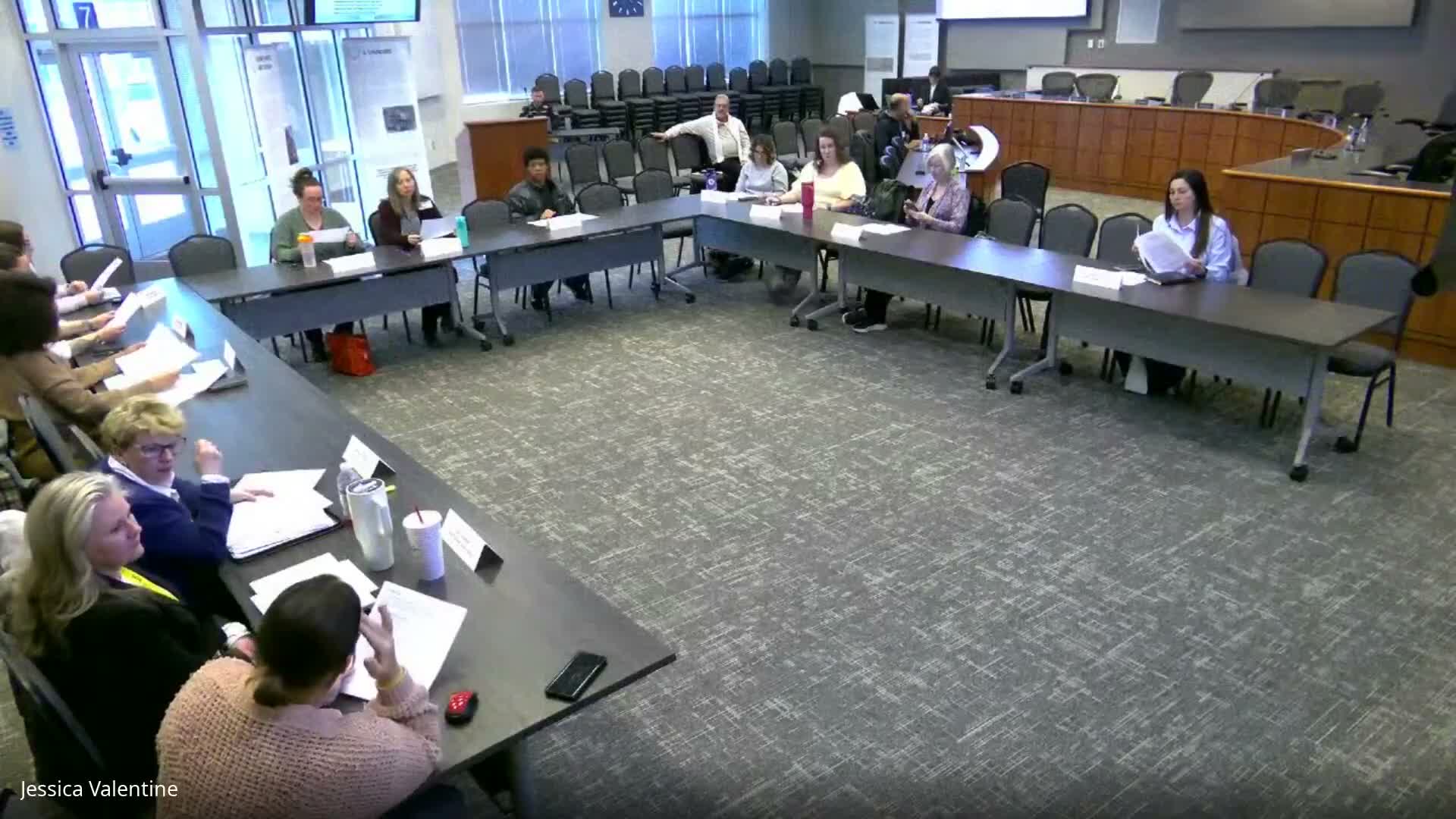
Summary
North Frederick County educators and staff reviewed the Maryland State Department of Education's elementary health 'family life' indicators, asking FCPS to clarify 'trusted adult' definitions, reconsider how 'gender assigned at birth' is phrased, and tighten language on reproductive‑system naming; feedback will be compiled for the board after state approval.
Frederick County Public Schools staff and community members met to review the Maryland State Department of Education (MSDE) elementary health framework’s family life indicators and to collect local feedback before the district presents recommendations to the FCPS board. The group spent the session noting wording concerns, grade sequencing questions and suggested local definitions to ensure age‑appropriate instruction.
The meeting facilitator (Speaker 3) told the group the purpose was to ‘‘review the elementary framework that was recently… the MSDE health framework’’ with a focus on family life standards and to gather ‘‘strengths, questions, gaps’’ that FCPS could take forward once the state approves the framework. Speaker 3 said the state had already approved the PE framework, that the health framework was expected to be approved by mid‑spring, and that FCPS aimed to bring compiled feedback to the board in April.
Participants emphasized that FCPS has local discretion. In response to a question about whether the county must adopt the state curriculum verbatim, Speaker 3 said, ‘‘We do not have to take the exact Maryland curriculum and move it forward. We can… make changes to them if we felt [we needed to].’’ The comment referenced a prior 2022 example in which state wording was revised after county feedback.
Several attendees raised terminology concerns. One participant (Speaker 1) challenged the phrase ‘‘gender assigned at birth,’’ asserting a biological framing: ‘‘Gender is determined by the sperm meets the egg,’’ and urging that biological language be clear so teachers do not conflate biology with other concepts. Other participants pressed for grade‑appropriate wording and noted that some potentially sensitive language had already been reworded by MSDE after earlier rounds of feedback.
The glossary term ‘‘trusted adult’’ was a recurring point. A participant (Speaker 1) requested clearer expansion because ‘‘there are some predatory people out there that look like trusted adults.’’ FCPS staff acknowledged that if MSDE does not define the term adequately, the district would develop a county‑level definition and implementation guidance. Speaker 3 later noted that indicators about identifying trusted adults appear in the mental and emotional health standards starting in pre‑K, saying, ‘‘There are standards on trusted adults in the mental and emotional health… starting in pre k.’’ Several educators suggested introducing the language earlier than fourth grade to support trauma‑affected students.
Attendees discussed grade sequencing for consent and personal body safety. Speaker 3 summarized third‑grade indicators as including a definition of consent and recognizing body language, social context and empathy; participants debated whether elements should be introduced earlier or repeated to reinforce learning across multiple years.
A fourth‑grade indicator (referenced in discussion as MD 1 c 4.6) that asked teachers to ‘‘identify human reproductive systems including medically accurate names for internal and external genitalia and their functions’’ drew focused comment. Speaker 4 said FCPS staff wanted clarity so the district could retain medically accurate naming while removing wording that participants felt might be confusing: ‘‘We put that on there… identify human reproductive systems including medically accurate names…’’ Several attendees suggested editing phrasing so expectations for lesson content are explicit and age‑appropriate.
The group followed a planned process: an initial individual review, small‑group work by grade band with note sheets, a gallery walk to read other groups’ feedback, and staff collection of the large notes and individual submissions. Speaker 3 said staff will compile the notes into an ongoing document and invited email followups: ‘‘Email anytime… Can you add this to the feedback? Go for it.’’ The next session was scheduled to review middle and high school (secondary) indicators in April.
No formal votes were taken; the meeting began without a quorum and ended after a motion to adjourn was seconded. Staff will present the compiled feedback to the FCPS board after the state finalizes the framework.
Sources: meeting transcript (Frederick County Public Schools advisory review of MSDE elementary health family life indicators).