Get Full Government Meeting Transcripts, Videos, & Alerts Forever!
Get email alerts on the Taxpayer Petition topic
No spam. Unsubscribe anytime.
Bloomington council finds taxpayer objection was late, says testimony doesn’t support budget changes
Summary
The Bloomington Common Council unanimously adopted findings that a taxpayer objection petition concerning use of food-and-beverage-tax revenues for a convention-center expansion was filed late and that the petition and testimony did not support modifying the proposed 2025 budget.
The Bloomington Common Council on Oct. 9 adopted findings concluding a taxpayer objection to planned spending on a proposed Monroe County Convention Center expansion was not timely filed and did not provide sufficient evidence to change the 2025 city budget.
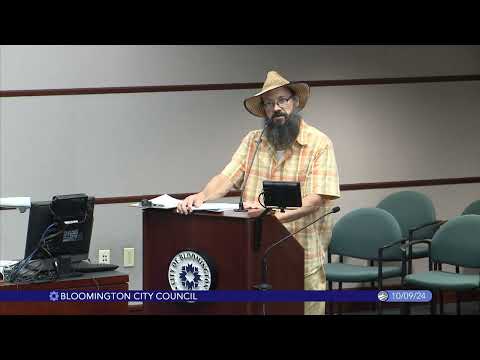
Joe Davis, who spoke for the petitioners, told the council the group opposed any appropriation of food-and-beverage-tax revenue or indirect funds toward the convention-center expansion and warned the petitioners could pursue legal action if appropriations continued. "We will file a class action civil tort against the executive and the legislative bodies of both city of Bloomington and county government," Davis said, arguing the CIB would lack local oversight and the project would serve out-of-town interests rather than city residents.
Jim Whitlatch, attorney for the Capital Improvement Board (CIB), countered that the petition was untimely under state law and contained procedural defects, including the absence of signatures. "The petition was not timely filed pursuant to the statute that requires that it must be filed no more than 7 days after the public hearing," Whitlatch said, and added the CIB has complied with formation requirements under state law and the interlocal agreement.
Council attorneys referenced Indiana Code 6-1.1-17-5 as the governing provision for petition filings and noted the deadline for filing was Oct. 2 at 11:59 p.m.; the petition was received Oct. 3 at 12:01 a.m. Council discussion focused on three issues: timeliness, whether evidence demonstrated inaccuracies or factual gaps, and whether testimony warranted modification of the appropriation ordinance. Several members said the council could strengthen findings by noting factual inaccuracies but ultimately favored a concise record.
A motion that the council adopt findings that (1) the petition was not filed in a timely manner and (2) the petition and testimony presented do not support modification of the budget passed by roll call vote, 9–0.
Next steps: the council adopted the findings into the record and proceeded with the remainder of the evening's agenda, including budget votes. The findings do not foreclose further legal challenges outside the council process.