Get Full Government Meeting Transcripts, Videos, & Alerts Forever!
Get email alerts on the Ordinance Votes topic
No spam. Unsubscribe anytime.
Ironton council adopts emergency ordinance barring registered offenders from public spaces, approves permit-fee update and AI moratorium; data-center zoning to‑
Summary
The Ironton City Council on Feb. 15 adopted ordinance 26‑07 banning registered offenders from specified public properties, approved updated permit fees, adopted a moratorium on AI data centers (26‑01) contingent on future zoning, and referred data-center zoning (26‑09) to the planning commission. Council discussed animal-sheltering language and use of the city demolition fund.
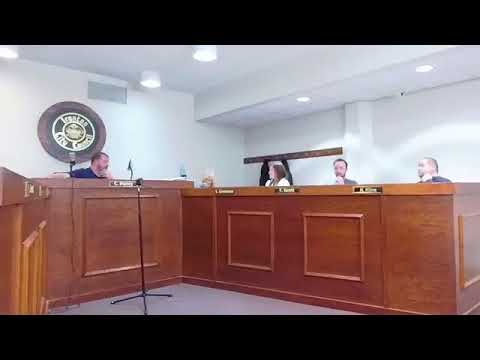
Ironton — The Ironton City Council voted on several ordinances at its Feb. 15 meeting, passing emergency legislation that prohibits registered offenders from being present on certain public properties, adopting updated permit fees, approving a moratorium on AI data centers, and referring data-center zoning to the planning commission.
The meeting began with a councilmember urging colleagues to "take this off the table" and amend the ordinance placed on the agenda to better protect children. Councilmembers said the measure — ordinance 26‑07 — was rewritten and expanded from schools to other public spaces where children gather. "We also added public spaces where children gather," one councilmember said, noting the superintendent recommended that in some cases a school resource officer accompany registered offenders who must appear for educational-decisions related to students. Gretchen Playful, executive director of the Griggs Lawrence County Public Library, asked what new responsibilities the ordinance would impose on the library and whether staff would need to modify background-check policies; city staff responded that the ordinance targets the individual offender and that police could be called and could cite offenders for violations.
After the public discussion the council asked the clerk to read ordinance 26‑07 by title, moved to suspend the rules to allow second and third readings by title only, and then moved and seconded a motion to adopt the ordinance. The clerk completed title readings and the council recorded the roll call; the presiding official declared ordinance 26‑07 adopted.
In related business the council considered ordinance 26‑08, which would prohibit unattended dogs or cats being left outside during inclement weather. Councilmembers compared the draft language with the Ohio Revised Code (ORC), debated whether to specify a technical requirement such as that a doghouse be at least 2 inches off the ground (language present in ORC), and discussed whether to define protection by a specific temperature threshold or by an "appropriate temperature" standard recommended by the humane society. The humane officer told council members that "appropriate shelter" under state law can include spaces such as under a porch or vehicle, and suggested adding a working definition. Councilmembers raised enforcement and vagueness concerns and discussed giving officers discretion rather than rigid numerical thresholds. A motion to amend Section 2 to add the two‑inch doghouse requirement was made and debated; the transcript records the amendment being put to roll call but the amendment vote is not unambiguously recorded in the public transcript.
On zoning and planning, the council read ordinance 26‑09 to add specific requirements for data centers and related accessory uses. Councilmembers said the strategic planning committee reviewed the item and recommended referral to the planning commission for a comprehensive review; the council voted to refer 26‑09 to the planning commission.
Councilmembers also suspended the rules and adopted ordinance 26‑10 to update permit fees. City staff said the fee schedule was a catch‑up — many permit fees had not been adjusted since 1997 — and that future CPI adjustments were expected to be applied comprehensively.
On data‑center policy, the council considered ordinance 26‑01 establishing a moratorium on AI data centers. Councilmembers amended section language so the moratorium would be rescinded automatically if and when ordinance 26‑09 (the zoning update) is passed, then moved and approved the amended moratorium by roll call. Council members said the moratorium provides a temporary pause (about 60 days was discussed) while zoning and regulations are finalized.
A separate discussion focused on the city demolition fund. One councilmember said he was surprised funds had been used to demolish the privately owned Delhi pharmacy building and asked why taxpayers were effectively subsidizing a private investor; council members and staff responded that demolition funds are generally used for condemned properties, can be reimbursed by insurance in some cases, and are tracked in fund 53 (the demolition fund) and fund 56 (state fire‑loss reimbursements). Council members asked staff to bring the question back for committee review; several asked for the issue to be discussed by strategic planning or finance committees prior to the next council meeting. One councilmember noted a roughly $40,000 demolition cost for the pharmacy demolition as an example to be examined further.
Before moving into an executive session to discuss contracts with the finance director and Mayor Schlisker (no action to follow), council announced a community cleanup (March 17–20) and recognized Ironton junior‑high basketball programs for recent successes.
Quotes from the meeting reflect the lines of debate: "I'm trying to figure out what the resistance is on this, on this issue," one councilmember said while urging the council to act on protections for children. Library director Gretchen Playful asked, "What responsibility does this put on the library to comply or to make it easier to comply?" City staff answered that the ordinance is written to target offenders and that police can be called if a violation occurs.
Next steps: ordinance 26‑07 is adopted as an emergency measure; ordinance 26‑09 has been referred to the planning commission for review; ordinance 26‑10 has been adopted to update permit fees; and ordinance 26‑01 (AI moratorium) was adopted as amended to tie its automatic repeal to passage of the data‑center zoning ordinance. The council moved into an executive session on contracts and no further public action was recorded during the open meeting.