Get Full Government Meeting Transcripts, Videos, & Alerts Forever!
Get email alerts on the Wildlife Conservation topic
No spam. Unsubscribe anytime.
Community science cameras and volunteers boost nest monitoring for South Shore snowy plovers
Summary
A volunteer‑driven monitoring program expanded camera coverage and volunteer surveys along the Great Salt Lake’s South Shore, improving nest‑fate detection and documenting predation and human disturbance that inform possible mitigation such as signage or seasonal closures.
Chelsea Cameron, who directs the South Shore snowy‑plover community‑science effort, reported that the project expanded from about 26 nest cameras in 2024 to roughly 50 this season and added a new reference site with no public access.
The program teams Tracy Aviary, local volunteers and partners to run nest surveys three times weekly, camera and Motus/CTT tracking deployments, and a recreational‑use observational survey at east/west entrances, foreshore and midshore access points. Cameron said cameras are deployed ~2 meters from nests on a time‑lapse schedule (one photo every 30 minutes) plus short motion videos to capture disturbances. The project’s volunteer network has grown and is central to data collection.
Preliminary results show higher accuracy in determining nest fate where cameras were used: presenters reported an observed nest success near 78% for nests with cameras versus about 30% for nests without cameras, though they cautioned that detection and sampling biases influence those numbers. Camera footage documented predation by coyotes, ravens and at least one snake species; it also showed human‑caused losses, including people stepping on nests and paramotor activity close to nests. Presenters said signs placed near cameras reduced accidental disturbance.
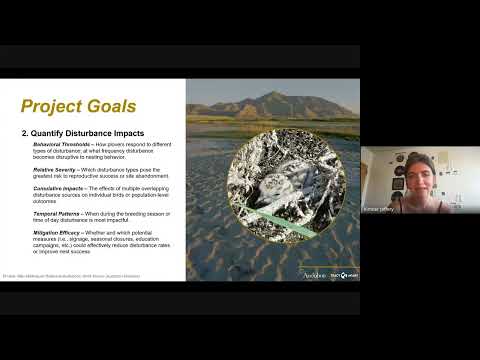
The team introduced a recreational‑use observational survey this year to quantify the timing, location and types of recreation, and plans a pilot visitor‑intercept (interview) survey in the fall to collect demographic information and gauge public support for mitigation options such as signage, seasonal closures or education programs. Chelsea Cameron said the program intends to publish its data and expand volunteer training.
The presentation closed with questions about whether nest distance from shore has shifted with changing lake elevation; the team said that analysis is ongoing and that preliminary evidence shows nests shift in response to freshwater inputs, vegetation cover and flooding events rather than a simple shoreline distance metric.