Maine committee debates new medical‑cannabis testing, tracking rules; roll call yields 5–5 with three absent
Loading...
Summary
The Joint Standing Committee on Veterans and Legal Affairs spent its Feb. 13 work session debating LD 18 47, a measure to require testing and inventory tracking for medical cannabis, add tax clarifications for pre‑rolls, and create limited financial assistance for small registrants; a Mallon motion drew a 5–5 roll call with three members absent and multiple committee reports expected.
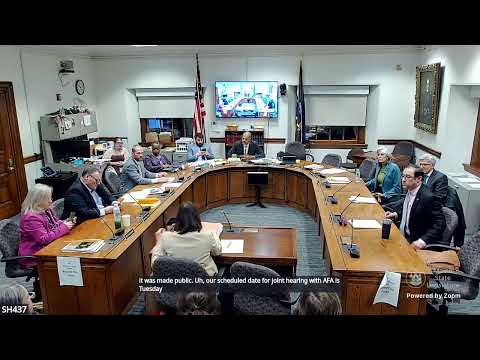
Augusta, Maine — The Joint Standing Committee on Veterans and Legal Affairs held a lengthy work session on LD 18 47 on Feb. 13, taking up competing amendments that would establish mandatory testing and an electronic tracking system for medical‑use cannabis, clarify excise taxation of pre‑rolled products, and direct how state funds might help small registrants pay testing costs.
Chair Sen. Greg Hickman opened the session by saying the committee would "work LD 18 47," which the committee described as a package to "institute testing, tracking of medical use cannabis and cannabis products, dedicate a portion of the adult use cannabis sales and excise tax to medical use cannabis programs, and create a study group" (Greg Hickman, Senator and chair).
The Office of Cannabis Policy (OCP) presented updated cost information. "I'm Gabby Berube Pierce. I'm the policy director for the Office of Cannabis Policy," Pierce told the panel, and she described per‑batch testing and inventory‑tracking fees drawn from recent contracts and four licensed labs. Pierce said permitted batch sizes for flower can be as large as 22 pounds (10 kg) and that inventory‑tracking fees would include a monthly vendor fee and per‑plant/package charges; she and her staff estimated a per‑gram cost model that included testing and labor assumptions (Gabby Berube Pierce, policy director, OCP).
Members pressed OCP on specifics. Some legislators asked whether excise or sales taxes were included in the OCP chart; Pierce said those taxes were not reflected in her cost table. On the design of batch testing, Pierce said the agency had consulted chemists and microbiologists and that "different strains create different microenvironments for yeast and molds and other microbials," which informed a strain‑based approach to sampling.
The session also revisited how the state has used the Maine Medical Use of Cannabis Fund. Committee staff reported an unencumbered fiscal‑year‑25 cash balance of $5,876,001 for the medical fund and noted the existence of an adult‑use public‑health fund with a larger balance. Members discussed whether some research or small‑business assistance could be funded from those existing accounts; Becca Bolas of the Maine Public Health Association told the committee that federal research dollars are generally unavailable while cannabis remains illegal at the federal level and that using the state fund for Maine‑based research would align with public‑health goals.
Representative Mark Mallon offered an omnibus motion that used Representative Annie Graham's amendment as the base and made multiple technical and policy changes, including: (1) adding a definition for "cannabis pre‑roll" to clarify excise taxation rules under Title 36 so pre‑rolls are taxed by composition (flower vs. trim); (2) directing OCP to run a competitive RFP for an inventory‑tracking vendor rather than automatically extending the adult‑use vendor to the medical program; and (3) creating a small‑registrant assistance program funded from the Maine Medical Use of Cannabis Fund to reimburse up to $100 per batch for registrants with under $125,000 in annual gross sales who can demonstrate testing costs exceed 10% of gross revenue.
Mallon stressed competitive procurement and small‑business relief but did not seek to finalize every technical drafting question in committee. OCP responded that it "does not find this to be a workable solution" in its current form and reiterated agency concerns about periodic audit testing, the proposed test panels, and the inventory‑tracking structure (Gabby Berube Pierce, OCP).
After extended debate — with members expressing sharply divergent views on whether mandatory testing would protect patients or unduly burden small caregivers — the clerk took a roll call on Representative Mallon's motion. The roll call recorded the following votes as announced by the clerk: Sen. Jill Dusan — yes; Sen. Greg Hickman — nay; Sen. Timberlake — absent; Rep. Annie Graham — yes; Rep. Parnell Terry — yes; Rep. Sharon Frost — absent; Rep. Quentin Chapman — no; Rep. David Boyer — no; Rep. Sue Spuica/Sue Pica (listed in the record as "Representative Sue Pica") — no; Rep. Frederick — no; Rep. Sean Faircloth — yes; Rep. Mark Mallon — yes. The clerk summarized: "5 members voting in favor of the motion with 5 members opposed to the motion and 3 members absent." Absent members were given the statutory opportunity to submit an absentia vote within the committee's deadline.
The roll call did not produce a clear, uncontested committee report; committee leaders indicated multiple reports would be filed (a majority report, a minority report and an 'ought not to pass' report), and staff will produce drafting revisions for language review prior to any final committee report.
What remains unsettled
- Scope and frequency of testing: the committee debated strain‑based batch definitions, final‑form testing for pre‑rolls, and whether audit sampling should be routine or complaint‑driven. OCP emphasized the need for rulemaking and clearer statutory direction.
- Funding and administration: members differed on whether to draw on the Maine Medical Use of Cannabis Fund or the adult‑use public‑health fund to subsidize testing or public‑health research. Committee staff reported an unencumbered balance of about $5.876 million in the medical fund (FY25 cash balance).
- Vendor selection and tracking: Mallon's motion directs a competitive RFP for medical tracking services; the timeline and procurement approach will require follow‑up.
Next steps
Committee chairs directed analysts to produce draft statutory language for the reported amendments and to coordinate language review; they said a revised package will be circulated before the next work sessions. Members also scheduled additional work sessions for the coming week and noted the absent members have until the statutory deadline to cast their votes in absentia.
— By the committee transcript and staff materials provided at the Feb. 13 work session.