
Committee advances bill tightening eligibility and capping credits for Maine’s early-college program
Get AI-powered insights, summaries, and transcripts
Subscribe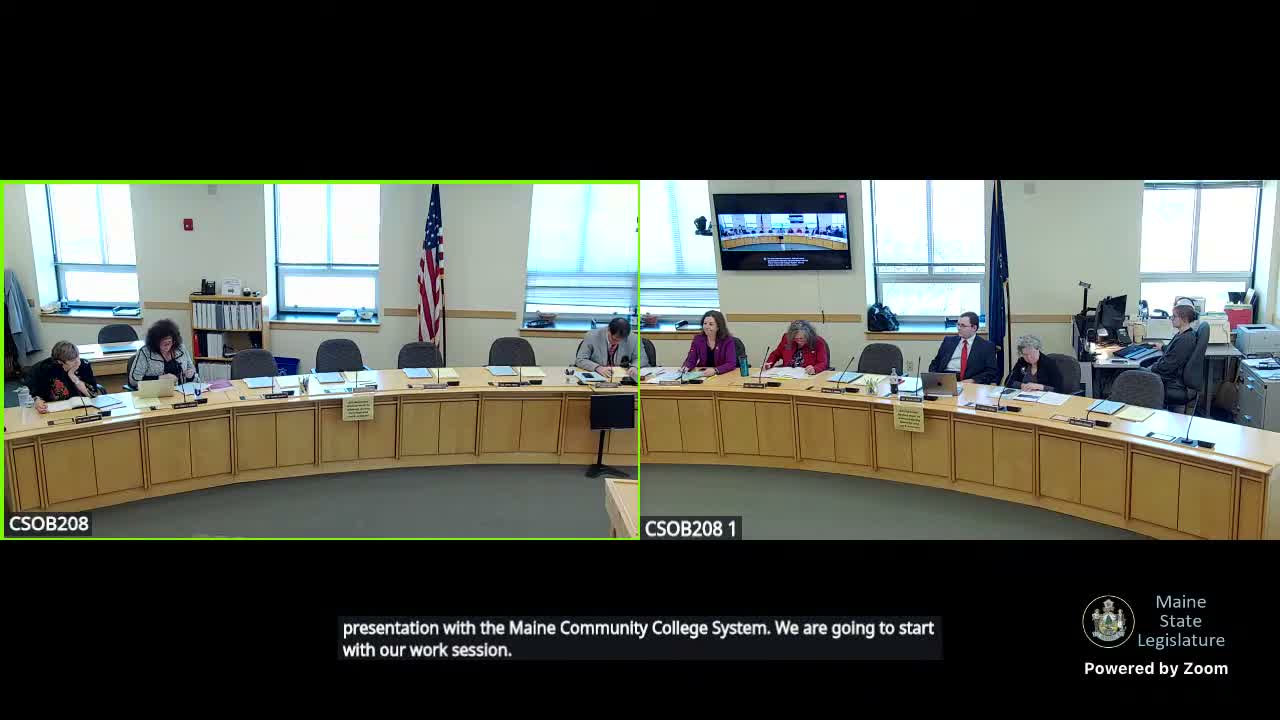
Summary
The Education and Cultural Affairs Committee voted to advance LD 2099, which sets lifetime credit limits (18 general, 24 for CTE pathways), narrows academic-eligibility language and places a two‑year sunset on the cap to allow a report-back. The committee recorded an 8–0 favorable count with the amendment.
Representative Kelly Murphy, chairing a work session of the Legislature’s Joint Standing Committee on Education and Cultural Affairs, moved that LD 2099 ‘ought to pass as amended’ after a department-led overview and testimony from higher-education partners. The amendment included a two‑year sunset with a required report back and lowered an underclassman GPA threshold to 2.0 rather than full repeal; Representative Murphy’s motion was seconded by Representative Jan Dodge and was approved by the committee with eight votes in favor and none opposed among those voting.
OPLA (the Office of Policy and Legal Analysis) described LD 2099 as a Department of Education bill that updates eligibility and academic requirements for the state’s Aspirations/early-college program (chapter 208‑A; Title 20‑A). Karen Neto (OPLA) told the committee the bill clarifies residency and enrollment categories, removes certain legacy academic‑standing provisions and establishes lifetime credit caps: 18 total credits for secondary students and 24 credits for career and technical education students in designated early‑college career pathways.
Witnesses from the University of Maine System and the Maine Community College System testified in support while flagging trade‑offs. Amy Hubbard, executive director of Early College for the University of Maine System, and Mercedes Poor, director of college access and secondary partnerships for the Maine Community College System, told the panel they and local schools now rely on school recommendations (school counselors, student‑services directors, principals or classroom teachers where appropriate) to judge a student’s readiness rather than a mechanical GPA cutoff for many underclassmen.
Sam Warren of the University of Maine System said the bill does not change the statutory reimbursement rate but acknowledged that, because the state appropriation has not kept pace with rising demand, the systems have voluntarily accepted lower per‑credit reimbursements. Warren told the committee that fiscal year 2025 statute language would have required roughly $168 per credit in reimbursement but the university accepted $60 per credit for dual‑enrollment courses in practice; the department’s ongoing appropriation for the Aspirations program is $5.5 million per year. Warren and other witnesses said fully reimbursing institutions at statutory rates last year would have required ‘‘a little above $8,000,000’’ across the two systems.
Committee members asked how caps would affect students in rural areas and those seeking additional access to courses. OPLA and system witnesses said the cap and concurrent‑enrollment adjustments were intended as parameters to keep program activity within the $5.5 million appropriation while maintaining broad access and program quality (advising, faculty development and course oversight). The amended motion includes a two‑year sunset limited to the provisions changing the cap and academic‑eligibility standards and requires a report from the Department of Education, the university and eligible institutions back to the committee.
The motion’s passage sends LD 2099 forward as amended. Committee staff noted that more detailed drafting and technical cleanup will take place in language review and that financial implications remain subject to appropriation action by the Legislature.