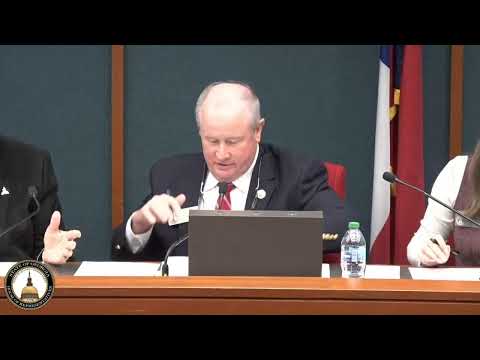
Committee advances bill to flag 'excluded drivers' in insurance records
Get AI-powered insights, summaries, and transcripts
SubscribeSummary
A House committee voted to advance House Bill 585, which would require insurers to report 'excluded drivers' to the state's insurance database so law enforcement can identify when a vehicle is uninsured, sponsors and witnesses said. Supporters said the change would help enforcement though victims still rely on uninsured-motorist coverage.
President Pro Tem Jones presented House Bill 585 to a House committee, saying the measure would require insurers to mark policies that list an "excluded driver" in the state system so officers can tell when a stopped vehicle is effectively uninsured.
"So the issue that I'm bringing before you is that when a consumer purchases automobile insurance, they can, if they want to, exclude drivers," Pro Tem Jones said, describing a substitute crafted with input from the insurance industry and the Revenue Department to ensure the technical reporting would work.
Pro Tem Jones and witnesses told lawmakers the change aims to close what they called a loophole: when an excluded driver operates a covered vehicle and causes an accident, the on-scene check of the state's insurance system appears to show the car is insured, but the insurer may later deny the claim because the driver was excluded.
Barry Schrank, president and owner of Taggart's Driving School, described two recent accidents involving his instructors in which the other driver was later identified as excluded. He told the committee he paid roughly $1,600 in one case and just under $1,000 in another, and that driving schools face limited insurer options and high uninsured-motorist deductibles: "I have a $2,000 deductible in uninsured motors," Schrank said.
An industry witness identified in the record as Bobby Potter of State Farm said insurers worked with the sponsor and support the bill. Potter summarized the measure this way: it would list excluded drivers in the state's GICS system so law enforcement could ticket excluded drivers and, under Section D of the bill, an owner who knowingly allows an excluded driver to operate the vehicle could face penalties outlined in the bill. Potter said the penalties range from a minimum fine (he cited a $200 figure as an example of a low-end penalty) up to "12 months in jail" as the maximum.
Committee members pressed sponsors and witnesses on two points: whether victims still shoulder costs under current law and how often the excluded-driver practice occurs. Pro Tem Jones and witnesses said victims typically rely on uninsured-motorist coverage for recovery and that there is no central tally of occurrences, though some traffic and magistrate judges have reported repeated instances.
After discussion and public testimony, the committee made and seconded a motion to advance the measure and the motion carried by voice vote. The transcript records 'Aye' but does not include a roll-call tally.
The bill’s supporters said the change would not alter existing coverage rules that make insurance "follow the vehicle"; instead, it would add reporting that helps officers and prosecutors determine whether a citation or criminal charge is appropriate in cases where an excluded driver operates a vehicle.