Get Full Government Meeting Transcripts, Videos, & Alerts Forever!
Get email alerts on the Budget topic
No spam. Unsubscribe anytime.
Public Works Commission approves two-year budget as city faces widening shortfalls
Summary
The Public Works Commission approved a two-year operating and capital budget for FY27 and FY28 after presentations noted a growing structural deficit, mayoral directives to cut general-fund spending, and potential cost pressures from a pending "Clean Streets and Fair Wages Act" that could raise costs for nonprofit workforce grants.
The San Francisco Public Works Commission voted Feb. 12 to approve the department's two-year operating and capital budgets amid warnings about large projected shortfalls and a pending local ordinance that could increase costs to nonprofit grant programs.
Bruce Robertson, Public Works' director of finance and administration, presented the department's proposed budgets: $441.8 million for fiscal year 2026''27 and $361.0 million for fiscal year 2027''28. Robertson said the current-year Public Works baseline is about $428.5 million and described an ongoing structural mismatch between expenditures and revenues across the city.
"Expenditure growth is $1.8 billion while revenue growth is $617 million," Robertson told commissioners, saying those trends produce estimated deficits of just under $300 million for FY27 and about $640 million for FY28. He said the mayor's budget office has instructed departments to cut $400 million in citywide general-fund ongoing expenditures and to reduce work orders and overhead by 10 percent.
The budget presentation emphasized efforts Public Works has taken to trim overhead and reorganize operations. Robertson described a set of mostly incremental actions he said would meet the initial reduction targets without cutting core services: shifting some positions to alternative funding sources, eliminating some vacant roles, and pursuing about $650,000 in ongoing labor reductions and roughly $250,000 in nonlabor savings.
The department also identified priority investments it would restore if additional funding becomes available, including a $9.3 million request to restore pit stop public-restroom locations and a consolidated project-management system to improve lifecycle tracking and cost control.
Commissioners pressed Robertson on trade-offs. Commissioner Wolford noted the decision to remain in a high-rent consolidated building carries citywide trade-offs, and Vice Chair Bloom asked whether Public Works risks being punished for having been proactive on reorganization. Robertson said the department has been negotiating with the mayor's office and that the administration has seen the reorganization as a cost-saving effort.
A major potential complicating factor flagged during the presentation was a Board of Supervisors measure introduced Jan. 27, the "Clean Streets and Fair Wages Act." Robertson said the proposal would "add prevailing wage requirements to contracts and grants for street cleaning services," listing services such as power washing and litter abatement, and estimated that a fully loaded prevailing-wage cost could be in the "$70 range" depending on final determinations. Robertson warned that, as currently proposed, the ordinance would affect four active nonprofit grant agreements for workforce-development cleaning programs (including the pit stop program) and could require bringing those workers in-house at classifications that would pay roughly $26 an hour for a pre-apprenticeship role or require seeking more than $10 million in new funding to maintain current program levels.
Director Carla Short told the commission she had met with Supervisor Malgar, the ordinance's sponsor, who "indicated a willingness to try to work with us on amendments," and said the department will continue to engage to protect workforce-development components while meeting the legislation's intent.
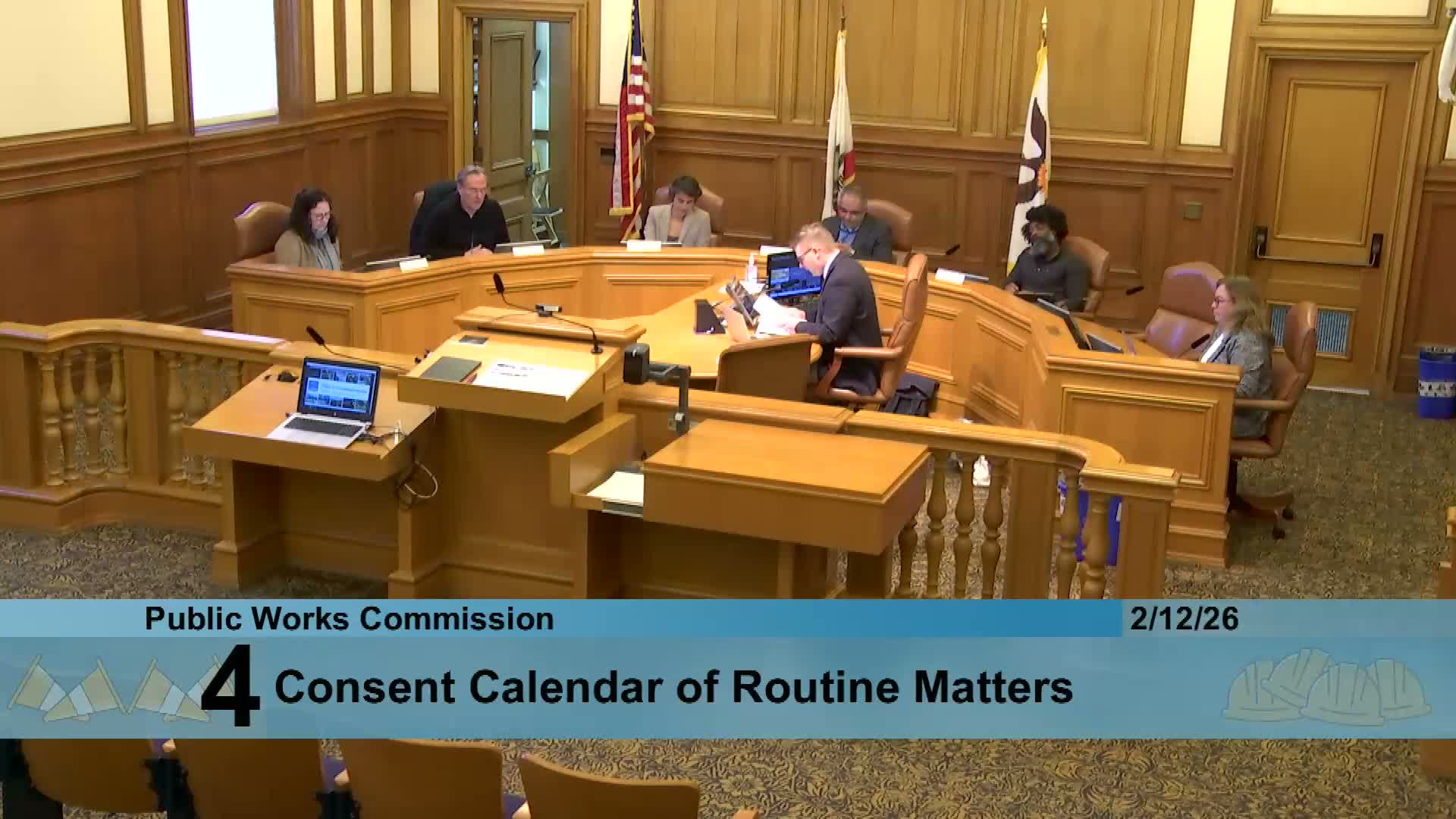
Public comment on the budget motion was invited; no members of the public spoke. The commission moved, seconded, and approved the budget by voice vote. The chair announced that the motion passes.
Votes at a glance
- Consent calendar (Item 4): Adopted by voice vote; no public comment. - Department of Public Works two-year operating and capital budget (Item 5): Approved by voice vote.
What happens next
Robertson and Director Short said the department will continue to refine capital estimates and return with updates as the mayor's office and Board of Supervisors consider the city budget. Vice Chair Bloom requested a follow-up presentation after budget decisions advance to the mayor and Board of Supervisors; the commission asked staff to place that item on a future agenda.