Get Full Government Meeting Transcripts, Videos, & Alerts Forever!
Get email alerts on the Meals Tax topic
No spam. Unsubscribe anytime.
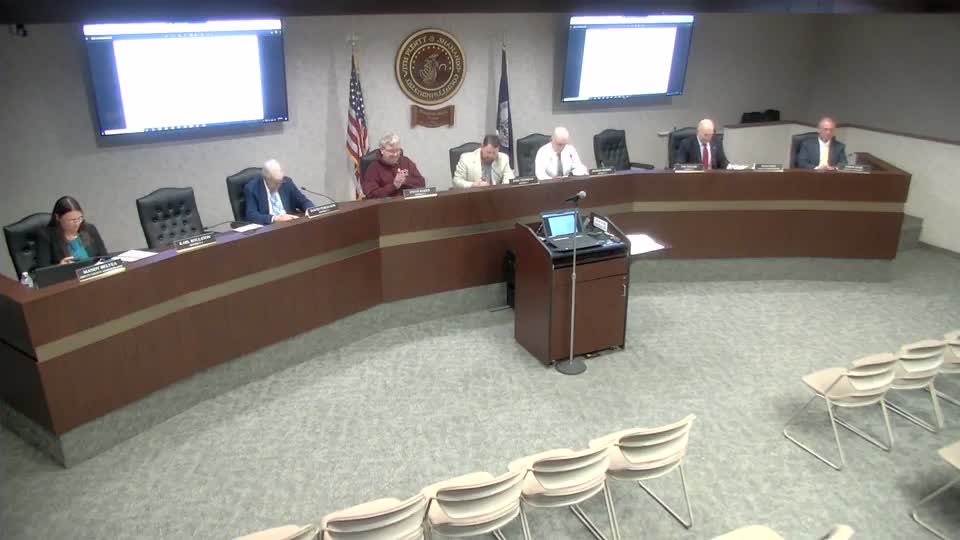
Shenandoah County holds public hearing on proposed 6% meals tax for unincorporated areas
Summary
The Shenandoah County Board of Supervisors heard a mix of support and opposition at a public hearing on a proposed 6% food-and-beverage tax for unincorporated areas, intended to fund public-safety capital; supporters cited equipment needs and estimated about $600,000 annual revenue, while wineries and tourism businesses warned of harm to visitation and small-business burdens.
The Shenandoah County Board of Supervisors held a public hearing on a proposed ordinance to levy a 6% food-and-beverage tax in the county's unincorporated areas, with revenues designated for public-safety capital and an effective date proposed of Feb. 1, 2026. The county presenter said the measure would apply to prepared food and beverages sold for consumption and would not fund operating costs such as salaries.
Why it matters: County officials said the levy would diversify a revenue stream that currently relies heavily on real and personal property taxes. Proponents said visitor spending would help shoulder the cost of expensive equipment such as ambulances and fire apparatus. Opponents, including winemakers and resort representatives, said the tax rate and administrative burden would harm rural businesses that depend on tourism.
Supporters and figures: Austin Mays, president of the Shenandoah County Career Firefighters Association, told the board the tax would "provide[] a dedicated stable source of revenue" and argued it would not raise property taxes. Mays cited the county budget's estimate that the levy "can bring in at least $600,000 in additional revenue to the county annually." Volunteer fire and rescue leaders also urged the board to approve the measure, saying fundraising has not kept pace with equipment costs and volunteer time is limited.
Opposition and concerns: Several winery owners and tourism stakeholders opposed the proposal. "This tax is excessive," Janelle Larrabee of Wolf Gap Vineyard said, comparing the proposed 6% rate to neighboring rural counties she said levy 4%. Sally Goll, president of the Shenandoah Wine Growers Association and co-owner of Muse Vineyards, said farm wineries are agricultural enterprises that "get very few, if any, of the services from the county" and would see little direct benefit from a countywide meals tax.
Business and administrative issues: Opponents also raised administrative concerns for small operators, including separating on-premise tastings from bottle sales meant to be taken home and the additional credit-card processing fees and point-of-sale changes required to comply with the ordinance. Tom Fugate, of the Bryce Resort Board of Directors, warned that higher costs could reduce visitation and overall revenue for tourism-dependent businesses.
Legal and technical points: A county presenter described the levy as the food-and-beverage tax defined in state code; as a Dillon-rule state, Virginia limits local taxing authority to categories enumerated in the code. The presenter noted commonly used exemptions for nonprofit fundraising and limited exceptions when a nonprofit's gross sales exceed statutory thresholds.
What's next: The public hearing was closed after the board received several in-person comments and letters; the presenter told the board the item will be on a future agenda for further discussion and possible action.