Get Full Government Meeting Transcripts, Videos, & Alerts Forever!
Get email alerts on the Enterprise Zone topic
No spam. Unsubscribe anytime.
Prince George supervisors approve amended enterprise zone ordinance, add parcels and reduce some incentives
Summary
The Board of Supervisors approved amendments to the county’s enterprise zone ordinance, adding two parcels and reducing the machinery-and-tools tax rebate from 100% to 50% for five years; changes will be submitted to the economic development authority and state and would be retroactive to Jan. 1, 2026 if approved by the state.
Prince George County’s Board of Supervisors voted unanimously Dec. 16 to adopt amendments to the county’s enterprise zone ordinance that add two parcels and scale back several local incentives intended to encourage commercial and industrial investment.
County staff presenter Mr. Jabari said the county currently maintains about 3,754 acres in two noncontiguous enterprise zone areas and proposed adding roughly 70 acres (including a former elementary school parcel and a roughly 54‑acre Massingburg parcel) to increase utilization to about 3,824 acres. He said the package also reduces the machinery-and-tools tax rebate from 100% to 50% for five years, adjusts water and sewer connection fee relief, and replaces a rezoning-fee waiver with an accelerated permitting priority because businesses value timing.
“The enterprise zone is to induce more investment within the zone to diversify our tax base,” Jabari said, adding that increasing commercial and industrial tax revenue helps fund services “like our fire and EMS, police [and] schools.” He noted the county’s Enterprise Zone resolution dates to 2009 and that any local ordinance amendments must be approved by the state before taking effect.
During the public-input portion, Vanessa of 11313 Cedar Run Road asked how the ordinance would affect homeowners, whether property taxes would rise and whether the county had protections for groundwater: “How is this gonna impact me as a homeowner? And are my property taxes gonna go up because of it? And does it address the gentleman’s concern about wells drying up due to construction?”
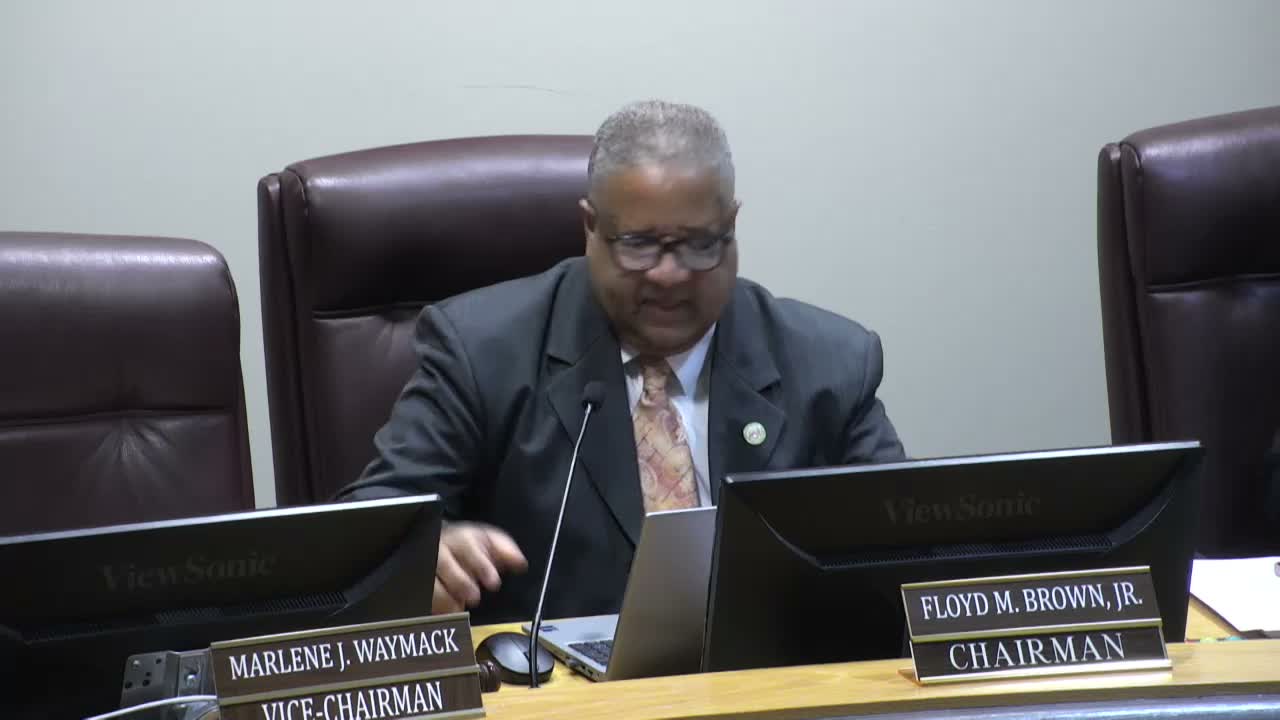
Jabari and Chairman Floyd M. Brown Jr. responded that the parcels proposed for addition sit where public utilities are already available and that, in their view, those parcels were not expected to rely on private wells. Jabari also explained the incentive change means the county would begin receiving at least 50% of machinery-and-tools tax revenue during the five-year period, rather than none under the prior 100% rebate.
Board members asked technical questions about rebate timing; Supervisor Cox asked whether the 50% rebate could be structured to be paid at the end of the fifth year as has been done elsewhere. Jabari said the county’s current practice is to begin tax assessment when a certificate of occupancy is issued and then rebate annually, but repayment structure could be considered.
Mr. Webb moved and Mr. Pew seconded a motion to approve the ordinance and the associated enterprise zone amendments. A roll‑call vote—Webb, Pew, Cox and Brown—was recorded as yes and the motion carried. Staff will forward the approved local ordinance and resolution to the Economic Development Authority for recommendation and then submit the package to the state; the presenters said, if the state approves, the local incentives would be retroactive to Jan. 1, 2026.
What’s next: The ordinance and amendment resolution will move to the Economic Development Authority for its approval before being sent to the state. If the state accepts the local amendments and applies them retroactively as requested, the reduced rebate and new boundary additions would take effect on Jan. 1, 2026.