
Executive Board hears bill to add economic-impact reports to fiscal notes
Get AI-powered insights, summaries, and transcripts
Subscribe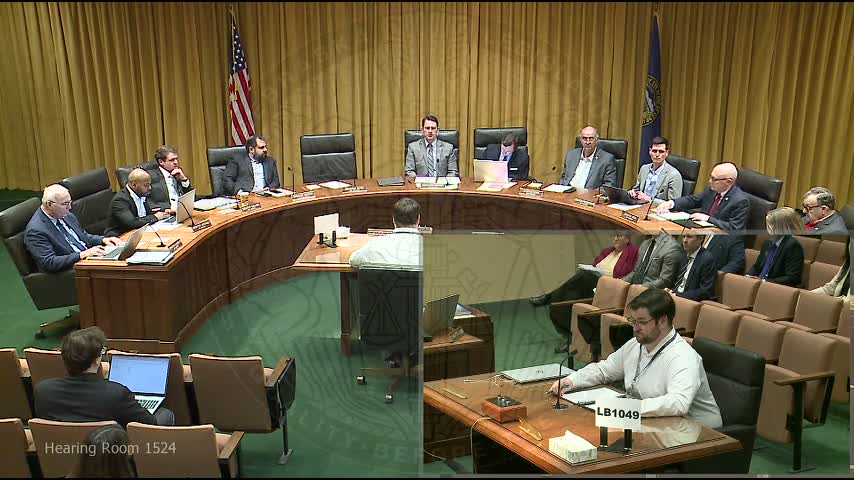
Summary
Supporters told the Executive Board LB 1049 would add an economic-impact report to fiscal notes for bills that prompt regulatory action and require an annual Secretary of State agency index; proponents said AI can speed brief estimates, while the legislative fiscal analyst warned of staffing, timing and quality constraints.
Chair Senator Ben Hansen opened the Executive Board hearing on LB 1049, presented by Tyler Mahood on behalf of the absent sponsor. Mahood said the bill would require the Legislative Fiscal Office to provide an economic-impact report along with the fiscal note for any bill that anticipates regulatory action and would ask the Secretary of State to compile a yearly index of rules and regulations for the Clerk of the Legislature.
Supporters argued the additional analyses would give lawmakers a clearer view of how legislation could affect businesses, property owners and families beyond the state budget. Laura Evke of the Platt Institute said the economic analyses would be “best guesses” but useful context and that modern tools allow the work to be done quickly. Jacob Myers, a Platt Institute intern, demonstrated an AI-driven template he said produced outputs in under 10 minutes per bill. Emily Amin of the Pacific Legal Foundation called the proposal a transparency measure, saying it “does not block regulations or create new approval hurdles.” Reeb Bull, former director of Virginia’s Office of Regulatory Management, described Virginia’s experience requiring cost‑benefit analyses for regulations and said pilot AI tools can accelerate reviews; he testified the state’s regulatory reforms helped produce an estimated $1,400,000,000 in annual savings.
The Legislative Fiscal Office provided neutral testimony. Fiscal analyst Keisha Potent said the office believes it could perform economic‑impact reports but raised concerns about the bill’s scope and timing. She said fiscal notes are often produced over weeks, noted the office must publish dozens of notes daily during session and that requiring additional in‑depth reports for every qualifying bill could necessitate more staff or narrower parameters. Potent told senators that the quality of such reports depends on available data and the time analysts have to review agency responses.
Committee members asked about criteria for which bills would qualify, state‑specific expertise in AI outputs, and whether AI results could mischaracterize simple authorization bills. Supporters acknowledged estimates are not guarantees and emphasized that human review and improved sourcing would be part of the process. Chair Hansen closed the record noting seven letters of support and no written opposition.
The committee did not take a formal vote on LB 1049; the hearing record will accompany any future committee action.